
Properties needing structural work are real estate opportunities priced significantly below comparable renovated homes, making them some of the most compelling deals in any market. These are not cosmetic fixer-uppers. They require substantial repairs to foundations, load-bearing walls, structural framing, or roofing systems. The gap between purchase price and after-repair value is where investors and contractors build real margins, but only when they find the right properties before the competition does.
Here is what qualifies as a property needing structural work, and the primary channels to locate them:
- Foundation issues: cracks, settling, bowing walls, or water intrusion at the base
- Structural framing failures: sagging beams, compromised joists, or damaged load-bearing walls
- Roof system deficits: decking rot, failed trusses, or structural deterioration beyond surface shingles
- Mold and water damage: pervasive moisture that has compromised framing or subfloor systems
- Search channels: MLS keyword filters, foreclosure and auction listings, public code violation records, distressed property data platforms, and direct agent outreach
How to find properties needing structural work across the right channels
The investors and contractors who consistently win on structural repair projects are not browsing the same public listings as everyone else. They build a sourcing system that pulls from multiple channels simultaneously, so they see opportunities before the crowd does.
MLS keyword filtering is the most accessible starting point. Searching terms like "fixer-upper," "needs work," "TLC," "as-is," or "sold as-is" on platforms like Zillow surfaces homes that most buyers avoid. These keyword searches narrow results to properties where sellers have already signaled distress or deferred maintenance, which often correlates with structural neglect.
Working with a real estate agent who specializes in distressed properties changes the game. These agents know which listings have been sitting, which sellers are motivated, and which neighborhoods have aging housing stock with deferred structural maintenance. A good distressed-property agent also has relationships with estate attorneys, probate courts, and bank REO departments, giving you access to deals that never hit public search.
- Foreclosure and short sale listings: Bank-owned (REO) properties and pre-foreclosure homes frequently carry deferred maintenance that crosses into structural territory. HUD's homes-for-sale portal lists government-owned properties, many of which are sold as-is.
- Auctions: County tax auctions and online property auctions regularly surface homes with structural issues. The tradeoff is limited inspection access before bidding.
- Public code violation records: Municipal building departments publish code violations, including structural citations. A property with an open structural violation is a direct signal of an opportunity.
- Permit history searches: Properties with expired or unpermitted structural work often have unresolved issues that suppress market interest and price.
- Probate and estate sales: Homes that have sat vacant through an estate process frequently develop structural problems from deferred maintenance and moisture intrusion.
The sharpest edge in sourcing comes from AI-powered signal platforms. Shovld tracks permits, code violations, HOA pressure, municipal records, and distressed-property indicators across U.S. real estate markets, converting scattered public data into scored, verified leads. Instead of manually checking county records across dozens of jurisdictions, investors and contractors get early-warning signals on properties before they ever hit a listing platform.
What to evaluate before committing to a structural repair project
Finding the property is only half the work. The evaluation phase is where deals get made or killed, and structural issues are the most common reason a promising project turns into a financial loss.
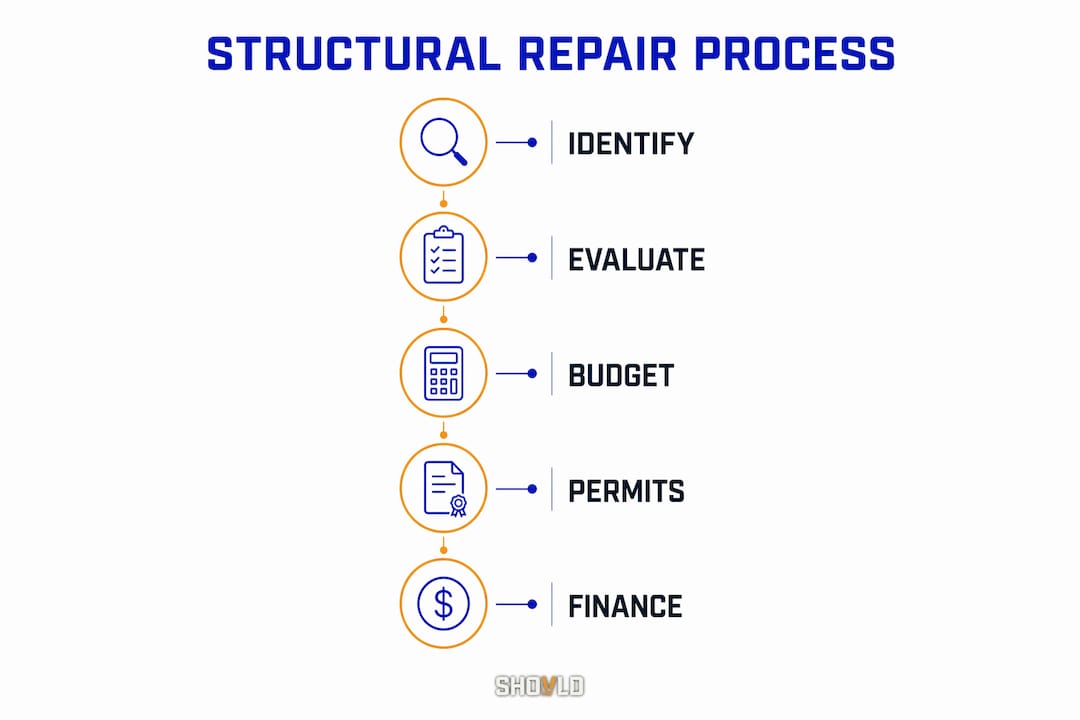
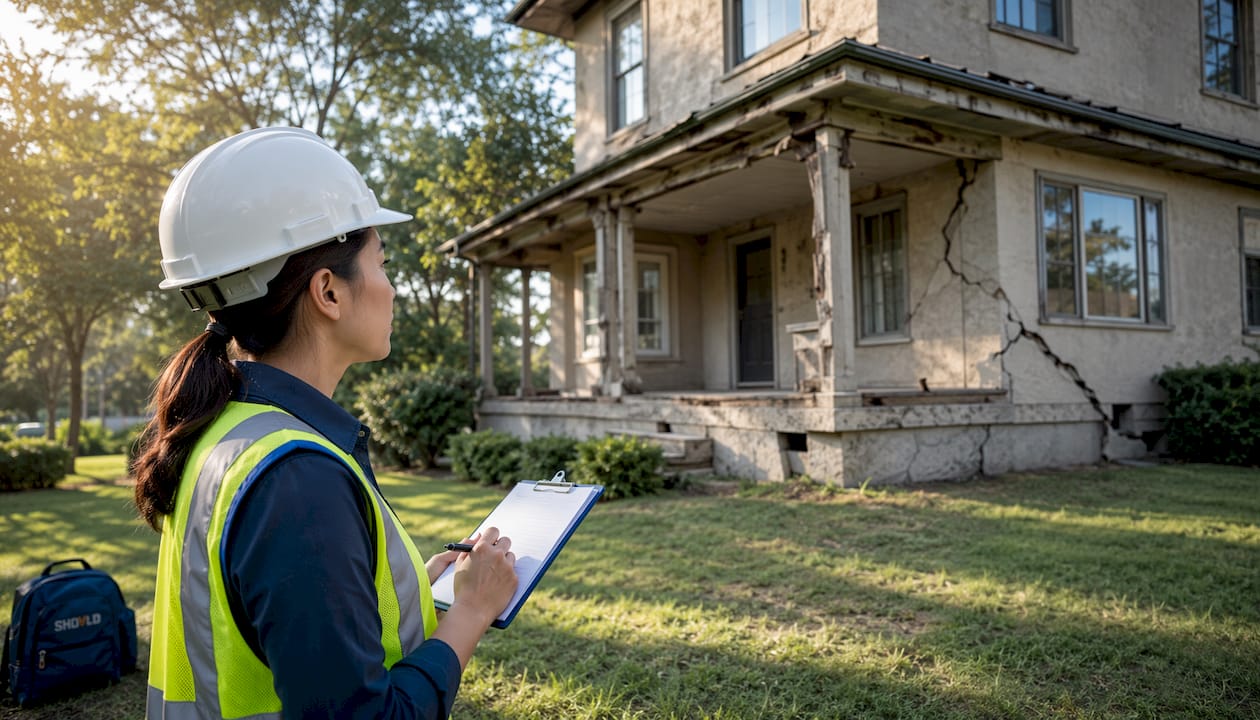
Professional structural inspection is non-negotiable. A licensed structural engineer inspection costs $500–$700 and provides the clearest picture of foundation integrity, load-bearing conditions, and framing failures. A general home inspector can flag surface concerns, but only a structural engineer can tell you whether a crack in the foundation is cosmetic settling or active movement that will require underpinning. That distinction separates a profitable project from a deal-killer.
Common structural problems to assess during evaluation:
- Foundation cracks and settling: Horizontal cracks in block foundations signal lateral pressure and are more serious than vertical shrinkage cracks.
- Sagging or deflected beams: Visible sag in floor systems or roof lines indicates overloaded or damaged structural members.
- Mold and moisture damage: Pervasive mold in framing or subfloor systems often means the structural wood has been compromised, not just stained.
- Roof deck deterioration: Soft spots or visible deflection in roof decking point to structural failure beyond surface shingles.
- Unpermitted structural modifications: Removed walls, added openings, or altered load paths without permits create both structural and legal risk.
Location and layout matter too. A structurally damaged property in a strong resale market can absorb higher repair costs. The same level of damage in a flat or declining market may never pencil out. Evaluate the neighborhood's comparable sales, the property's floor plan viability, and whether the layout supports the end use you are targeting.
Pro Tip: The single most reliable way to separate a cosmetic fixer-upper from a structural money pit is to bring a licensed structural engineer before you make an offer, not after. The $500–$700 inspection fee is the cheapest insurance you will buy on any renovation project.
Budgeting for structural repairs requires building in a contingency from the start. Structural repairs often trigger compounding costs: opening walls to fix framing reveals outdated wiring; correcting a foundation issue requires excavation that uncovers plumbing failures. Structural repairs tend to reveal additional expenses not visible at purchase, so a 15–20% contingency on top of your initial repair estimate is a practical baseline, not a conservative one.
Legal and permitting requirements add another layer. Structural work in most U.S. jurisdictions requires building permits, and some municipalities require engineered drawings before issuing them. Factor permit fees, plan review timelines, and potential code upgrade requirements into your total project cost before you finalize an offer.
How to buy and finance a property with structural issues
Purchasing a home with structural problems follows a different path than a standard transaction. Most of these properties are sold as-is, meaning the seller makes no repairs and provides limited or no disclosures. That shifts the burden of discovery entirely to the buyer.
Financing is the first obstacle. Conventional lenders will not fund a property that fails a standard appraisal due to structural deficiencies. That leaves buyers with three primary options:
- Cash: The fastest and cleanest path. No lender conditions, no appraisal contingencies, and the ability to close quickly, which matters when competing for distressed inventory.
- Bridge loans: Short-term financing that covers acquisition and sometimes initial repairs, typically at higher interest rates. Used by investors who plan to refinance or sell after stabilization.
- FHA 203(k) loans: The Standard 203(k)_Consumer.pdf) program combines purchase and rehabilitation costs into a single loan with no maximum renovation amount, and explicitly covers structural repairs. It requires an FHA-approved 203(k) Consultant to oversee the work and mandates that all building permits be obtained before work begins.
Structuring the purchase offer correctly protects your position. Include an inspection contingency that specifically covers structural findings, and build your offer price around your estimated after-repair value minus total renovation costs and your required profit margin. If the structural inspection reveals issues beyond your initial estimate, the contingency gives you room to renegotiate or exit.
Title searches are critical on distressed properties. Liens, unpaid taxes, HOA arrears, and boundary disputes are common on homes that have been neglected or passed through financial distress. A clean title is not guaranteed just because a property is listed for sale. Engage a real estate attorney early, particularly on foreclosure, probate, or bank-owned acquisitions.

Timeline expectations matter for planning. A typical structural repair project runs longer than a cosmetic renovation. From offer acceptance to closing on an as-is property can take 30–60 days. Permitting for structural work adds weeks in many jurisdictions. The construction phase for major structural repairs commonly runs 3–6 months depending on scope, and that timeline affects your carrying costs, financing terms, and resale or rental timing.
Budget line items to account for before closing:
- Structural engineer inspection and report
- Title search and real estate attorney fees
- Permit fees and plan review costs
- Contingency reserve on top of contractor estimates
- Carrying costs during the renovation period (taxes, insurance, loan interest)
Forecasting after-repair value and managing structural risk
After-repair value (ARV) is the projected market value of the property once all repairs are complete. Every financial decision on a structural repair project flows from this number, and getting it wrong is the most common reason deals fail to deliver expected returns.
ARV forecasting starts with comparable sales. Pull recent closed sales of renovated properties within a tight geographic radius, matching square footage, bedroom and bathroom count, and condition. The gap between your all-in cost (purchase plus total renovation) and the ARV is your gross margin. Structural damage like sagging foundations or pervasive mold is a frequent deal-killer when margins are insufficient, because repair costs escalate faster than most initial estimates account for.
The risk profile of structural repairs is different from cosmetic work. Cosmetic renovations have predictable costs and timelines. Structural repairs do not. Opening a wall to sister a damaged joist can reveal a compromised sill plate, which requires foundation work, which uncovers drainage issues. Each discovery compounds the budget. Experienced investors build worst-case scenarios into their ARV models, not just best-case projections, and they walk away from deals where the margin of safety disappears under realistic repair assumptions.
Code compliance adds a layer of cost that many buyers underestimate. Bringing a structurally deficient property up to current building code often means upgrading adjacent systems that were not part of the original repair scope. Electrical panels, plumbing configurations, and insulation standards may all require updates once permits are pulled for structural work. These costs are real and should be estimated before closing, not discovered during demolition.
Legal and title risks specific to distressed properties can stall or kill a project entirely. Title complexity in distressed acquisitions often involves multi-layered liens that take months to resolve. A property with a clouded title cannot be sold or refinanced until the title is cleared, which extends your holding period and increases carrying costs. Early legal review is not optional on these deals.
Shovld's AI platform addresses the timing problem that undermines most structural repair investments. By tracking property distress signals from permits, code violations, and municipal records before properties reach public listings, Shovld gives investors and contractors early visibility on opportunities while the competition is still waiting for the MLS to update. That early position translates directly into better purchase prices and more negotiating leverage.
A few risk management principles that experienced buyers apply consistently:
- Never rely on a single contractor estimate for structural repairs. Get at least three bids and use the median, not the lowest.
- Treat the structural engineer's report as the baseline, not the ceiling. Budget for findings beyond what the report identifies.
- Verify that your exit strategy (flip, rental, or refinance) is viable in the current market before committing to a structural repair project.
- Confirm that your financing structure can absorb a 20–30% cost overrun without requiring a capital call mid-project.
Key Takeaways
Properties needing structural work offer price discounts of 30–50% below comparable renovated homes, but only disciplined sourcing, rigorous evaluation, and conservative budgeting convert that discount into actual profit.
| Point | Details |
|---|---|
| Price discount opportunity | Structural repair properties are typically priced 30–50% below comparable renovated homes. |
| Engineer inspection first | A licensed structural engineer inspection ($500–$700) is the most reliable way to assess true project risk before making an offer. |
| FHA 203(k) covers structural work | The Standard 203(k) loan combines purchase and rehab into one loan with no maximum renovation amount, and explicitly covers structural repairs. |
| Title and legal checks are critical | Distressed properties frequently carry liens, unpaid taxes, or title issues that can stall a deal for months without early legal review. |
| Early signals beat public listings | AI-powered platforms like Shovld surface distressed property opportunities from public records before they reach the open market. |
Shovld gives you the early position that changes the math

Most investors and contractors are crowded around the same fire, competing on the same MLS listings, bidding at the same auctions, and losing margin to the same competition. Shovld breaks that pattern. The platform converts permit data, code violations, HOA pressure, and municipal records into scored, verified leads on properties that have not yet reached public listings. You see the opportunity when the seller is still deciding whether to list, not after thirty other buyers have already submitted offers.
For real estate investors targeting structural repair projects, that timing advantage is the difference between buying at a real discount and paying market rate for a distressed property. Shovld's signal intelligence plans are built for professionals who want a predictable pipeline of early-stage opportunities, not a reactive search process.