
Most investors who set out to find undervalued properties needing work spend weeks chasing leads that are already picked over. The deal that looks like a bargain on a listing site has usually been passed on by three other buyers for a reason, or it has already been scooped up by someone with earlier access. The real opportunity in distressed real estate sits upstream, before a property hits the open market, before the competition crowds in. This guide covers how to identify, evaluate, finance, and close on fixer-upper homes the right way, from spotting a pricing gap to managing a rehab without blowing your budget.
Table of Contents
- Key takeaways
- How to find undervalued properties needing work
- Assessing repair scope and after-repair value
- Legal, financial, and hidden risk factors
- Financing options for fixer-upper properties
- Executing the purchase and renovation
- What I have learned from investing in properties that need work
- How Getshovld helps you act before the market does
- FAQ
Key takeaways
| Point | Details |
|---|---|
| Spot the pricing gap early | Compare a property's asking price to nearby renovated comps to confirm genuine undervaluation before you make an offer. |
| Scope repairs before you commit | Separate cosmetic fixes from structural problems and build a detailed Scope of Work before finalizing your numbers. |
| Run legal due diligence first | Title searches and lien checks before closing prevent costly surprises that can erase your projected profit. |
| Match financing to the project | FHA 203(k) and similar renovation loans let you finance purchase and rehab together, but eligibility depends on credit score and renovation scope. |
| Use signal data for early access | Platforms that track permits, code violations, and distressed-property indicators surface opportunities before they reach the MLS. |
How to find undervalued properties needing work
The industry term for what most people call a fixer-upper investment is a distressed property. The two phrases overlap, but distressed real estate is the broader category. It includes foreclosures, code-violation properties, deferred-maintenance homes, and anything where the owner's circumstances or the property's condition creates a pricing gap versus what the home would be worth after repairs.
Identifying undervalued properties starts with a straightforward comparison: what are nearby renovated homes selling for, and how far below that number is this property priced? That gap is your working margin. If it does not cover renovation costs plus profit, the deal is not a deal.
Beyond pricing, the physical signals matter. Properties with outdated kitchens and bathrooms, worn flooring, and dated fixtures are cosmetic fixer-uppers. They are the lower-risk entry point. Properties with sagging rooflines, visible foundation cracks, or moisture staining around windows are signaling something deeper. You need to know which category you are looking at before you make an offer, not after.

Neighborhood selection is just as important as the property itself. Emerging areas with rising sales volume, new business openings, and improving school ratings tend to produce better after-repair values than stagnant markets. A cosmetic rehab in a neighborhood with strong demand will outperform a deeper renovation in a flat market almost every time.
For sourcing, no single channel dominates. Combining MLS searches, relationships with local agents who know off-market inventory, courthouse auction lists, and online distressed property platforms gives you the widest funnel. Agents with strong neighborhood ties often know about properties before they list, which is where the real advantage lives.
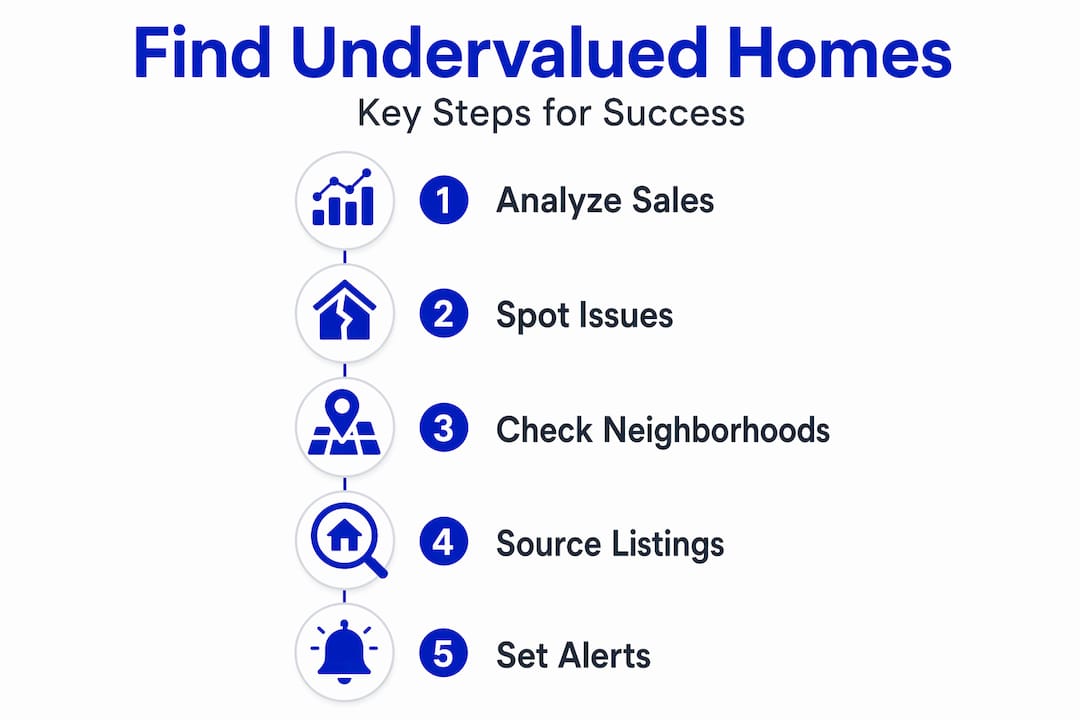
Pro Tip: Set up automated MLS alerts filtered by days on market over 60 and price reductions over 10%. Properties sitting that long are often priced with room to negotiate, and sellers are usually motivated.
Assessing repair scope and after-repair value
Once you find a candidate, the next job is separating what the property needs from what it will be worth when you are done. This is where most investors either make money or lose it.
The difference between cosmetic and structural repairs is not just about cost. It is about risk. Cosmetic work, paint, flooring, fixtures, appliances, is predictable. You can get bids, compare them, and hold contractors to scope. Structural work, foundation repairs, roof replacement, mold remediation, load-bearing wall changes, carries far more uncertainty. Costs can escalate quickly when walls open up and reveal surprises.
A thorough home inspection before closing is not optional. It is the document that drives everything else. Foundation issues, active roof leaks, and mold behind walls are the three categories that most commonly turn a good-looking deal into a loss. Get a licensed inspector and, for older properties, a separate structural engineer review if anything looks questionable.
From the inspection, you build a Scope of Work. A well-organized SOW breaks down every repair by trade and line item. Electrical, plumbing, HVAC, framing, roofing, finishes. Each line gets a unit cost and a quantity. This is not just good project management. Lenders reviewing rehab loan applications scrutinize the SOW for organization, defensible costs, and contingency to justify financing and the after-repair value.
After-repair value, or ARV, is the number the entire deal hinges on. Consider a real example: a property purchased for $1 million with $1.2 million in renovation costs, later appraised at $2.4 million and generating $7,500 per month in rental income. The math worked because the ARV was verified before the renovation began, not hoped for afterward.
Here is a simplified comparison of repair categories and their risk profiles:
| Repair type | Cost predictability | Impact on ARV | Risk level |
|---|---|---|---|
| Cosmetic (paint, flooring, fixtures) | High | Moderate to high | Low |
| Mechanical (HVAC, plumbing, electrical) | Moderate | Moderate | Medium |
| Structural (foundation, roof, framing) | Low | High if unresolved | High |
| Environmental (mold, lead, asbestos) | Low | High if unresolved | Very high |
Budget contingency is where inexperienced investors consistently cut corners. A contingency between 5% and 15% of total renovation costs is the range lenders and experienced investors consider realistic. Below 5% signals inexperience. Above 15% suggests the scope itself is uncertain, which is a different problem.
Pro Tip: Get a minimum of three contractor bids for any scope over $25,000. Not to find the cheapest bid, but to identify outliers that signal either scope misunderstanding or a contractor who will cut corners to hit a low number.
Legal, financial, and hidden risk factors
Properties requiring renovations often carry liabilities that do not show up in a listing description or a visual walkthrough. These are the risks that turn a good deal into an expensive lesson.
The most common hidden problems include:
- Unpaid liens: Contractor liens, tax liens, and HOA liens attach to the property, not the owner. You inherit them at closing if you do not catch them first.
- Permit violations: Work done without permits creates code compliance issues that can halt your renovation or require expensive tear-out and redo.
- Incomplete prior renovations: Abandoned mid-project work can leave structural systems in a compromised state that is not obvious from a surface inspection.
- Construction disputes: Active or unresolved litigation tied to prior contractors can cloud title and complicate financing.
Hidden liabilities like these can drastically reduce the net investment value of a property that looks attractive on paper. The trap is that distressed properties often come with distressed histories, and those histories leave legal fingerprints.
A title search and lien check before closing is non-negotiable. Early legal review prevents post-close surprises that no amount of renovation skill can fix. If the title comes back with complications, you negotiate a price reduction, require the seller to clear the lien, or walk away. All three are better than discovering the problem after you own the property.
"The investors who consistently win in distressed real estate are not the ones who find the best deals. They are the ones who walk away from the wrong ones." This is the discipline that separates professionals from people who got lucky once.
Involve a real estate attorney for any property with a complicated history. The cost of a legal review is a fraction of what a single unresolved lien can cost you after closing.
Financing options for fixer-upper properties
Most conventional mortgages will not fund a property in poor condition. That is where renovation-specific loan products come in, and understanding them gives you a real advantage when you identify cheap investment properties that others cannot finance.
The FHA 203(k) loan is the most widely used tool for this purpose. Credit scores of 580 or higher qualify for 3.5% down. Scores between 500 and 579 require 10% down. The loan finances both the purchase and the renovation in a single closing, which eliminates the need to carry a separate construction loan.
There are two versions. The Limited 203(k) covers cosmetic work up to $75,000 in renovation costs and has simpler requirements. The Standard 203(k) requires a HUD-approved consultant for structural renovations and involves more oversight, but it handles larger and more complex scopes.
Beyond FHA products, two conventional alternatives are worth knowing:
- Fannie Mae HomeStyle: Covers renovation costs up to 75% of the completed appraised value. Works for investment properties, not just primary residences.
- Freddie Mac CHOICERenovation: Similar structure to HomeStyle, with slightly different eligibility rules and contractor requirements.
One operational reality that catches investors off guard: renovation loans require licensed contractors with draw disbursements tied to inspections. You cannot pay a contractor in full upfront and get reimbursed. Funds release in stages as work is verified. This makes contractor reliability as important as the deal itself. A contractor who disappears mid-project on a 203(k) loan can freeze your draws and put you in a very difficult position.
Pro Tip: When budgeting for a renovation loan, add lender fees, required inspections, mortgage insurance premiums, and a hazard insurance policy for a property under construction. These costs are real and often underestimated by first-time rehab buyers.
Executing the purchase and renovation
Finding the property and securing financing gets you to the starting line. The execution phase is where deals succeed or fail in practice.
- Negotiate with repair costs in hand. Your inspection report and contractor bids are negotiating tools. A documented $40,000 foundation repair estimate justifies a $40,000 price reduction request. Sellers of distressed properties expect negotiation. Come prepared with numbers, not feelings.
- Vet contractors before you need them. Check licenses, insurance, references from similar projects, and their experience with rehab loan draw processes. A contractor unfamiliar with inspection-linked disbursements will create friction on every draw request.
- Build a project tracking system. A shared spreadsheet with budget line items, scheduled completion dates, and actual spend updated weekly catches overruns before they compound. You cannot manage what you do not measure.
- Pull every required permit. Unpermitted work creates problems at resale, refinance, and inspection. Licensed contractor work and permit compliance are also required for FHA 203(k) and most rehab loan products. Skipping permits is not a shortcut. It is a liability you carry until you sell.
- Stay present during the rehab. Weekly site visits, photo documentation, and regular communication with your contractor are not micromanagement. They are how you catch scope creep, substituted materials, and schedule drift before they become expensive problems.
Pro Tip: Before the renovation starts, photograph every room and every system. If a dispute arises about what was pre-existing versus contractor-caused damage, that documentation is the difference between a quick resolution and a protracted argument.
What I have learned from investing in properties that need work
I have seen investors walk away from genuinely great deals because the paperwork looked messy, and I have seen others rush into properties with clean listings that turned into money pits. The pattern is consistent. The deals that go wrong almost always had a warning sign that someone rationalized away.
The "too good to be true" instinct is worth trusting. When a property is priced significantly below comps and the seller is motivated to close fast, there is usually a reason. Sometimes it is a legitimate life circumstance. Sometimes it is a lien, a permit nightmare, or a structural problem the seller hopes you will not find. Thorough due diligence is not pessimism. It is the job.
Contractor reliability is the variable that most investors underestimate until it costs them. I have watched distressed properties sit half-renovated for months because the original contractor walked off a job. The deal math assumed a four-month timeline. The actual timeline was eleven months. Carrying costs alone erased a significant portion of the projected return.
Legal oversight has saved me real money. A title search on a property I was close to closing on revealed a contractor lien from a prior owner's renovation dispute. The seller had no idea it existed. We renegotiated the price to account for the resolution cost, and I closed with a clean title. Without that review, I would have inherited the problem.
The investors who consistently find early opportunities are not smarter. They have better information, earlier. Using platforms that track construction signal data and public-record indicators puts you in front of opportunities before they become crowded. That timing advantage is worth more than any single deal tactic.
— Avi
How Getshovld helps you act before the market does
If you are serious about finding distressed real estate before it hits the open market, the gap between you and the competition is almost always a timing problem. Most investors are reacting to the same listings, the same auction notices, and the same word-of-mouth leads. Getshovld is built to close that gap.

Getshovld's AI-powered signal intelligence platform tracks permits, code violations, HOA pressure, deferred maintenance patterns, and other public-record indicators across multiple U.S. markets. It transforms scattered municipal data into verified, scored opportunities so you can act before a property reaches the MLS. For real estate investors who want to search for rehab properties with a real edge, that early visibility changes the math entirely. Explore platform pricing options to see which plan fits your market and deal volume, or learn how Getshovld works to understand exactly what signals the platform surfaces and why they matter.
FAQ
What makes a property "undervalued" vs. just cheap?
An undervalued property is priced below what it would sell for after repairs, based on comparable renovated homes nearby. A cheap property may simply be in a weak market with no upside after renovation.
How do I locate bargain homes before they hit the MLS?
Build relationships with local agents who specialize in distressed inventory, monitor auction lists and code violation records, and use signal intelligence platforms that track early-stage property distress indicators.
What is the difference between a Limited and Standard FHA 203(k) loan?
The Limited 203(k) covers cosmetic renovations up to $75,000 with simpler requirements. The Standard version handles structural work and requires a HUD-approved consultant to manage the scope and inspection draws.
How much contingency should I budget for a fixer-upper renovation?
A contingency between 5% and 15% of total renovation costs is the realistic range. Below 5% signals an underestimated scope. Above 15% suggests the project scope is not well-defined enough to proceed confidently.
What hidden risks should I check before buying a distressed property?
Run a title search and lien check to surface unpaid contractor liens, tax liens, and permit violations. Also review any prior renovation history for incomplete work or construction disputes that could complicate your project or financing.