
Deferred maintenance is the accumulation of overdue repairs and postponed capital replacements that increase near-term liability on any asset. On a first site visit, look immediately at the roof, building envelope, HVAC, plumbing, and electrical systems — these five categories account for the majority of costly surprises after acquisition or management transition.
Top 5 red flags to spot on sight and in records:
- Visible water stains on ceilings, walls, or around mechanical equipment
- Multiple layers of roofing material or patchwork flashing repairs
- HVAC units that appear aged and may have no documented replacement history
- Outdated electrical panels (Federal Pacific, Zinsco, or fuse-box configurations)
- Open work orders that have been open for more than 30 days with no scheduled close date
Immediate actions to protect your negotiating position:
- Photograph every deficiency with timestamps and GPS-tagged location notes before leaving the property.
- Request the last 24 months of work orders, PM logs, and contractor invoices within 48 hours of your initial walk.
- Get at least two contractor estimates for the top three capital items before submitting or revising an offer.
Table of Contents
- What deferred maintenance actually means for property professionals
- Common examples of deferred maintenance and what drives the backlog
- What to look for on a site walk and how to document it reliably
- Which records and public data reveal a hidden maintenance backlog
- How to classify severity: from minor repairs to C4/C5 conditions
- How to estimate replacement costs and build a defensible capital plan
- How to triage deferred items and build a remediation plan
- A practical due-diligence checklist for buyers and property managers
- How public-record signals and AI detection reveal deferred-maintenance patterns
- How deferred maintenance affects appraisals, financing, and insurance
- Key Takeaways
- The field habits that actually protect your position
- Shovld gives you the signal before the site walk
- Useful sources and reference materials
What deferred maintenance actually means for property professionals
Deferred maintenance is upkeep that has been delayed past its recommended interval or a capital component that has not been replaced at end of life. The term covers both routine preventive maintenance (PM) that slipped and major system replacements that were budgeted but never funded.
It is worth separating this from a healthy maintenance backlog. A planned backlog — work that is scheduled and sequenced — is normal and even desirable. Deferred maintenance is the subset that is overdue, unscheduled, and actively raising the risk of failure. The distinction matters because sellers and managers sometimes present a large backlog as proof of active management when the underlying work is months or years past due.
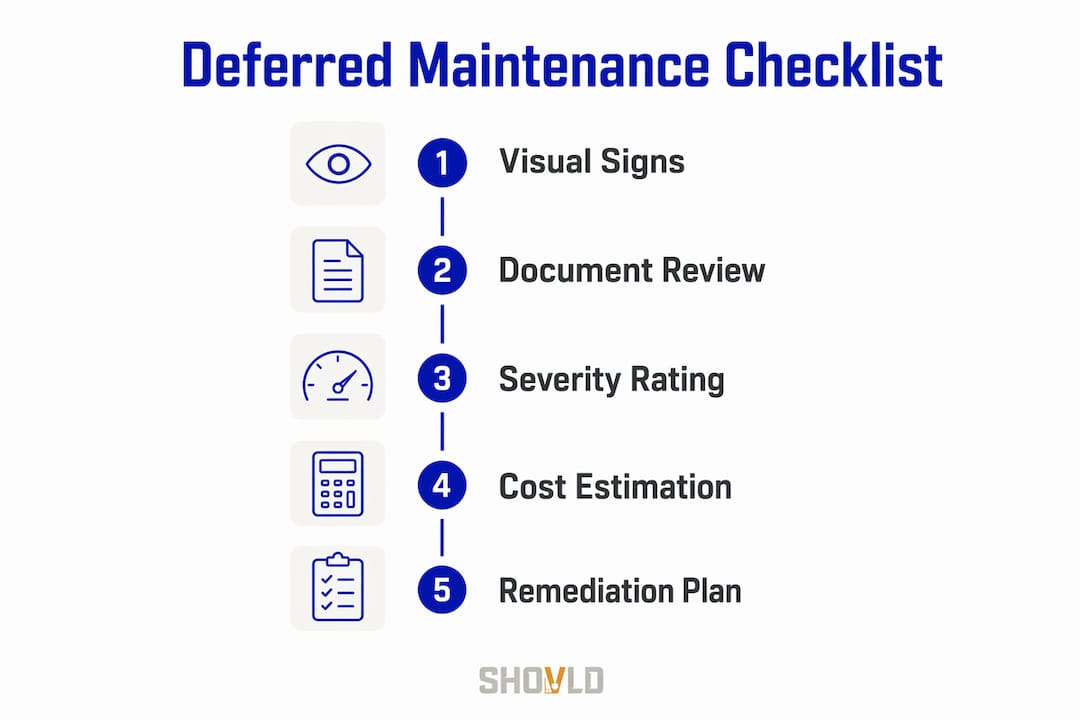
In the acquisition risk stack, deferred maintenance sits at the intersection of tenant operations, capital planning, and lender/insurer requirements. A property with significant deferred items can face appraisal adjustments, lender repair conditions, and insurance exclusions simultaneously, compressing both value and financing options at the worst possible time.
Common examples of deferred maintenance and what drives the backlog
The most frequently deferred items fall into predictable categories, each with its own downstream consequence.
Common deferred items by system:
- Roofing: Failed flashing, missing shingles, ponding water on flat roofs. Consequence: active leaks, structural staining, mold growth.
- Exterior envelope: Cracked caulking, deteriorated siding, failed window seals. Consequence: moisture intrusion, insulation loss, tenant complaints.
- HVAC: Units past 15–20 year service life, dirty coils, failed economizers. Consequence: tenant churn, emergency replacement costs, code violations.
- Boilers and hot water systems: Corroded heat exchangers, expired pressure vessels. Consequence: safety hazards, insurance non-renewal.
- Plumbing stacks: Galvanized or cast-iron drain lines past service life. Consequence: chronic leaks, sewer backups, habitability issues.
- Electrical panels: Outdated panels, double-tapped breakers, missing arc-fault protection. Consequence: fire risk, failed inspections, lender holds.
- Paving and site work: Cracked asphalt, failed drainage, deteriorated curbing. Consequence: liability exposure, ADA compliance risk.
- Mold and moisture history: Unresolved water intrusion events. Consequence: health hazards, insurance claims, tenant litigation.
The root causes behind these backlogs follow a short list: budget constraints that push capital replacements into the next fiscal year, ownership transitions where no one inherits institutional knowledge, weak vendor relationships that delay scheduling, staffing shortages that reduce PM compliance, and occupancy pressure that discourages disruptive repairs. When several of these factors stack, the backlog compounds quickly.
What to look for on a site walk and how to document it reliably
Approach every site walk with a systems-first lens. Before you evaluate finishes or curb appeal, answer these questions for each major system: What is the approximate age? Is there evidence of recent repair or only deferred attention? Are there signs of temporary fixes rather than full replacements?
For each area, ask:
- Roof: Any ponding, patched areas, or exposed substrate? When was the last full replacement?
- Mechanical rooms: Are unit data plates legible? Do serial numbers indicate manufacture dates beyond expected service life?
- Common areas: Are there water stains, efflorescence, or fresh paint over stains?
- Unit interiors: Do drains flow freely? Are there odors, soft spots in floors, or evidence of amateur electrical work?
Structured inspections that require an explicit condition rating and a photo for every flagged defect convert subjective visual checks into verifiable records you can trend over time. A photo without a timestamp and a location note is nearly useless in a negotiation or insurance dispute.
Non-obvious red flags that experienced professionals learn to catch: repeat repairs in the same location (a ceiling patched three times without addressing the source), patchwork flashing rather than a full membrane replacement, electrical tape on junction boxes, extension cords used as permanent wiring, and clogged floor drains in mechanical rooms. These patterns signal that the property has been managed reactively, not proactively.
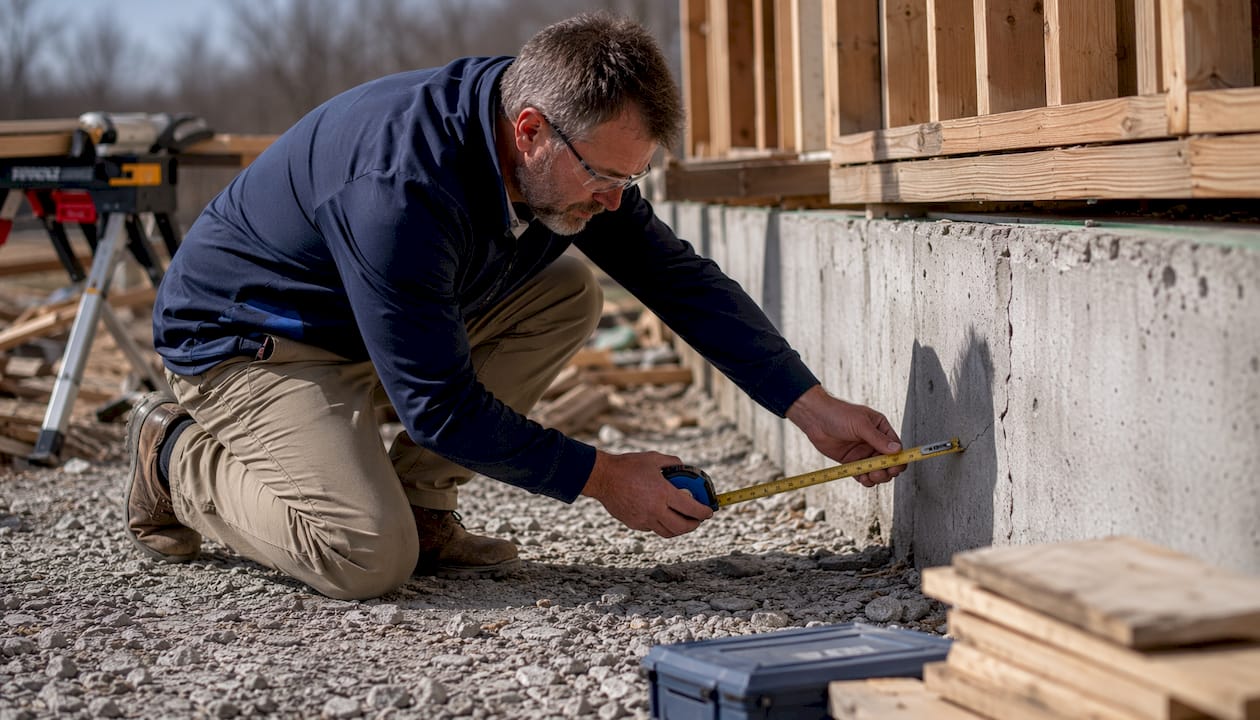
Pro Tip: When you find a temporary fix, photograph the fix and the surrounding area. A single patch is a data point; three patches on the same roof section is a pattern that supports a full-replacement credit request.
Escalate to a licensed engineer or specialist when you see foundation cracks with horizontal displacement, active leaks with structural staining extending more than a few feet, or major HVAC corrosion that suggests refrigerant or heat-exchanger failure. Visual inspection alone cannot quantify those risks.
Which records and public data reveal a hidden maintenance backlog
Documents tell the story that a single site walk cannot. Request these in priority order:
- Last 24 months of work orders, sorted by system and open/closed status
- PM compliance reports (percentage of scheduled PMs completed on time)
- Contractor invoices and vendor contracts, particularly for HVAC, roofing, and plumbing
- Capital expenditure history for the past five years
- Warranty transfer documents for any major system replacements
- Unit turnover records (high turnover often correlates with deferred conditions)
- Any open contractor estimates that were never acted upon
Early warning signs in the records are often more reliable than visual cues: preventive maintenance pushed back repeatedly, open work orders growing faster than closures, and recurring defect reports on the same system. A PM compliance rate that has dropped from 90% to 70% over 18 months is a measurable signal that the backlog is growing before any visible failure appears.
Public records add a layer that internal documents cannot fake. Pull building permits for the past five years and look at the ratio of repair permits to renovation permits, any open permits that were never closed, and code violation histories. HOA meeting minutes and complaint logs, insurance claim histories, and tax assessor condition notes all carry signal. A property with three roofing repair permits and no replacement permit in 15 years is telling you something specific.
Pro Tip: Check permit submission histories for patterns of small, repeated repairs on the same system. Contractors who pull multiple small permits instead of one replacement permit are often working around a budget constraint, not solving the underlying problem.
How to classify severity: from minor repairs to C4/C5 conditions
Fannie Mae's property condition ratings give buyers and appraisers a shared language for severity. C4 indicates minor deferred maintenance — items that need attention but do not impair the property's function or habitability. C5 signals obvious deferred maintenance where significant components are near or at end of life, though the property remains functional.
Use this severity checklist for each major system:
- Age vs. expected life: Is the component within its service life, approaching end of life, or past it?
- Repair frequency: Has the same system required repeated repairs in the past 24 months?
- Evidence of temporary fixes: Are there patches, bypasses, or workarounds in place?
- Health and safety impact: Does the condition create a habitability or code-compliance risk?
- System redundancy: Is there a backup, or does failure mean immediate loss of function?
| System | C4 Indicators | C5 Indicators | Recommended Next Step |
|---|---|---|---|
| Roof | Minor flashing repairs, 1–2 years from end of life | Active leaks, multiple patch layers, past end of life | Full replacement estimate |
| HVAC | Unit 12–15 years old, functional but aging | Unit 18+ years, frequent failures, no service records | Engineer review + replacement budget |
| Electrical panel | Minor code gaps, functional | Outdated panel type, double-tapped breakers, failed inspection | Licensed electrician assessment |
| Plumbing stack | Minor slow drains, no active leaks | Galvanized lines past service life, recurring backups | Repipe estimate + camera inspection |
| Boiler | Approaching end of service life | Corroded heat exchanger, expired pressure vessel | Immediate specialist review |
Pro Tip: If the same failure appears across a representative sample of units — say, half of the units you inspect show the same drain issue — treat it as systemic deferred maintenance and model the capital cost against the full asset, not a single-unit repair.
How to estimate replacement costs and build a defensible capital plan
Cost estimation for deferred items is where most buyers leave money on the table. Inspection reports list component ages without translating them into dollar liabilities, which means the negotiation defaults to the seller's framing.

The practical approach: collect at least two contractor quotes for each major item, then apply a present-value method to convert age into a credit request. The formula is straightforward:
Replacement Cost × (Remaining Life ÷ Total Life) = Remaining Value
Subtract remaining value from full replacement cost to get the defensible credit. For a component at or past end of life, the full replacement cost is the credit request.
Key cost drivers to account for:
- System replacement cost: Get current contractor quotes, not online averages — labor and material costs vary significantly by market.
- Access and phasing constraints: Occupied buildings require phased work, which adds cost and time.
- Code-upgrade ripple costs: Replacing an electrical panel often triggers arc-fault and GFCI upgrades throughout the unit.
- Local permit and inspection fees: Factor these into every estimate.
- Contingency: Budget 10–30% for unknowns, particularly on older buildings where opening walls reveals additional problems.
| System | Typical Lead Time | Contingency Range |
|---|---|---|
| Roof replacement | 2 weeks (weather-dependent) | 15% |
| HVAC replacement | 1–4 weeks per unit | 10–20% |
| Plumbing repipe | 3 weeks (occupied building) | 20–30% |
| Electrical panel upgrade | 1–3 weeks | 10–15% |
How to triage deferred items and build a remediation plan
Not every deferred item demands immediate action. The triage framework that works in practice follows a clear priority order:
Priority 1 — Safety and code risks: Active electrical hazards, structural movement, gas leaks, and habitability violations. These cannot be deferred further. Address before closing or require seller remediation as a closing condition.
Priority 2 — Systems at end of life: Components that will fail within 12–24 months. Budget these as near-term capital items, not long-term reserves.
Priority 3 — Revenue-impacting conditions: HVAC failures, plumbing leaks, and envelope issues that drive tenant complaints and turnover. These affect NOI directly and should be scheduled within the first operating year.
Priority 4 — Cosmetic items: Deferred painting, landscaping, and worn finishes. Address these on a rolling basis as budget allows.
A practical remediation plan has three time horizons: short-term fixes completed within 60 days of acquisition (safety items, active leaks), a medium-term contractor schedule for system replacements in months 3–18, and a long-term capital replacement timeline with triggering conditions (e.g., "replace boiler when repair cost exceeds 30% of replacement cost").
Pro Tip: Negotiate seller credits for Priority 1 and Priority 2 items specifically. Presenting a written contractor estimate for the top three items secures stronger credits than a general "deferred maintenance" reduction request with no documentation behind it.
Funding options include repair reserves built into the acquisition budget, seller credits escrowed at closing, phased capital projects tied to lease renewals, and clear owner-versus-tenant responsibility assignments in the lease structure.
A practical due-diligence checklist for buyers and property managers
Use this checklist during offer, escrow, and pre-close to avoid capital surprises after acquisition.
Documents to request pre-offer or at inspection:
- Contractor estimates for any known deferred items
- Last 24 months of maintenance budgets vs. actual spend
- Open work order roll-up by system and age
- PM compliance reports for the past 12 months
- Vendor contracts and service agreements (HVAC, elevator, fire suppression)
- Equipment serial numbers for all major systems (enables manufacture-date verification)
- Any pending insurance claims or open code violations
Questions to ask sellers and managers directly:
- When was each major system last replaced, and is there documentation?
- Are there any recurring vendor invoices for the same issue on the same system?
- Are there pending insurance claims, open permits, or unresolved code violations?
- Has any system been repaired more than twice in the past 24 months?
Contract protections to include:
- Escrow holdbacks tied to specific replacement timelines
- Itemized repair credits supported by contractor estimates
- Closing conditions requiring seller remediation of Priority 1 safety items
- A requirement that contractor estimates accompany any credit request
Systemic deferred maintenance shows up in representative samples. Walking one unit and declaring the building sound is a common and costly mistake. Walk at least 20% of units on any multifamily acquisition and compare findings across the sample.
How public-record signals and AI detection reveal deferred-maintenance patterns
The most reliable way to find properties with deferred maintenance before a site walk is to read the public-record signals that precede visible failure. These signals are scattered across permit databases, code-violation records, and HOA complaint logs, but they follow recognizable patterns.
Signals that indicate a deferred-maintenance pattern:
- Multiple small repair permits on the same system within 36 months (roof patches, HVAC service calls, plumbing repairs) with no replacement permit
- Code violation clusters on the same property, particularly repeat violations
- Low permit-to-close ratios (permits pulled but not finaled suggest incomplete or abandoned repairs)
- HOA complaint spikes tied to specific systems or units
- Insurance-claim clusters on a single address
- Contractor permit spikes from multiple vendors on the same property (reactive, not planned)
- Open work order metrics that show a growing ratio of open to closed orders
A practical signal workflow:
- Pull permit history for the target address and flag any system with three or more repair permits and no replacement in the past 10 years.
- Cross-reference with code violation records and HOA complaint data.
- Request open work order roll-ups and PM compliance reports from the current manager.
- Run a targeted site walk focused on the systems flagged by the signal data.
- Generate a scored opportunity with documented evidence for follow-up or negotiation.
This is exactly the kind of workflow where Shovld's signal intelligence platform accelerates results. Shovld aggregates permit data, code violations, HOA records, and distressed-property indicators across multiple U.S. markets, scores each opportunity by urgency, and delivers a prioritized list of properties showing deferred-maintenance patterns. Instead of manually pulling records across five databases, professionals get a verified, scored lead with the evidence already assembled. For contractors and restoration companies, that early visibility is the difference between being first to the door and arriving after the work is already bid out.
How deferred maintenance affects appraisals, financing, and insurance
Appraisers adjust value downward when deferred maintenance is visible and documentable. A roof past end of life, an HVAC system with no service history, or plumbing with recurring issues all support negative condition adjustments in a comparables-based analysis. The adjustment is not always proportional to actual repair cost — appraisers often apply a conservative estimate that may understate or overstate the true liability, which is why having contractor estimates in hand before the appraisal is scheduled matters.
Lenders react to condition ratings directly. Fannie Mae's C4/C5 framework influences how conventional lenders treat repair conditions. A C5 rating typically triggers a lender requirement for immediate correction of health and safety items before loan funding. Properties with active leaks, failed electrical panels, or structural hazards can be flagged for escrow holdbacks or outright declined until repairs are completed.
Insurance underwriting red flags tied to deferred maintenance:
- Roofing systems older than 20 years often trigger exclusions or higher premiums
- Outdated electrical panels (Federal Pacific, Zinsco) may result in coverage denial
- Unresolved water intrusion history raises mold-exclusion risk
- Boilers and pressure vessels past certification dates can void coverage
How property condition shapes insurance outcomes is often underestimated during acquisition. A property that looks financeable on paper can face coverage gaps that only surface after closing. Documented contractor estimates and a clear remediation timeline help underwriters assess risk accurately and reduce the chance of post-close coverage disputes.
This article provides general information for real estate professionals. Confirm current lender requirements, appraisal standards, and insurance guidelines with qualified professionals for your specific situation.
Key Takeaways
Deferred maintenance is most reliably identified by combining a systems-first site walk with public-record signals and documented contractor estimates — not by visual inspection alone.
| Point | Details |
|---|---|
| Start with five systems | Roof, envelope, HVAC, plumbing, and electrical account for the majority of deferred-maintenance liability on any asset. |
| Use C4/C5 ratings to classify severity | Fannie Mae's condition ratings give buyers and appraisers a shared standard: C4 is minor deferred maintenance; C5 signals components near or at end of life. |
| Convert age to dollars | Apply Replacement Cost × (Remaining Life ÷ Total Life) to build a defensible credit request backed by contractor estimates. |
| Read the records before the walk | PM compliance drops, growing open work order ratios, and repeat repair permits are earlier warnings than visible failures. |
| Shovld surfaces these signals automatically | Shovld aggregates permit histories, code violations, and distressed-property indicators across U.S. markets to deliver scored, evidence-backed deferred-maintenance leads. |
The field habits that actually protect your position
The most common mistake professionals make when assessing deferred maintenance is treating the site walk as the primary evidence source. Visual inspection is a starting point, not a conclusion. A freshly painted ceiling hides a water stain; a new coat of exterior paint hides failed caulking. The records and the public data are harder to cosmetically improve.
Sequence matters. Pull public records and request internal documents before the site walk, not after. When you arrive knowing that a property has three roofing repair permits and a code violation for electrical in the past four years, you know exactly where to point your camera and which contractor to call first. Walking in blind and then requesting records puts you in a reactive position.
Getting credible contractor estimates quickly is a skill worth developing. A general contractor who does everything is rarely the right call for a deferred-maintenance assessment. Call a roofing contractor for the roof, an HVAC specialist for mechanical, and a licensed electrician for panels. Specialists give faster, more defensible estimates than generalists, and lenders and appraisers treat them as more credible evidence.
The other common mistake: negotiating every cosmetic finding alongside the capital items. Sellers tune out when buyers present a 40-item list of minor deficiencies. Focus your written credits on the top two or three high-cost items with contractor estimates attached. That approach, backed by specific contractor estimates, consistently produces stronger results than a broad, undocumented reduction request.
One more pattern worth watching: a managed backlog is not the same as deferred maintenance. A property manager who shows you a 3-week work order backlog with a 90% PM compliance rate is showing you a healthy operation. A manager who shows you 200 open work orders with no close dates and a PM compliance rate that has been declining for 18 months is showing you a capital liability. Learn to read the difference.
Shovld gives you the signal before the site walk
Most professionals spend hours pulling permits, cross-referencing code violations, and requesting records manually before they can even decide whether a property is worth visiting. Shovld eliminates that bottleneck.

Shovld tracks permit histories, code-violation clusters, HOA complaints, and distressed-property indicators across multiple U.S. markets and scores each property by urgency. For contractors, restoration companies, and real estate professionals focused on deferred-maintenance opportunities, that means receiving a prioritized list of properties showing repeating small-repair permits, rising open work orders, and code-violation patterns — before anyone else has knocked on the door. The evidence is already assembled. The opportunity is already scored. Your job is to show up first.
If finding properties with deferred maintenance is part of your business model, see how Shovld's signal intelligence plans fit your market and trade.
Useful sources and reference materials
- Fannie Mae Selling Guide — Property Condition and Quality: Primary reference for C4/C5 condition ratings and lender treatment of deferred maintenance.
- Deferred Maintenance Pricing Framework — Botway Docs: Practical present-value formula and negotiation guidance for converting component age into a defensible credit request.
- Maintenance Backlog Definition and Benchmarks — Coast: Explains acceptable backlog benchmarks (2–4 week planning backlog) and how to distinguish managed backlog from deferred maintenance.
- Early Signs of a Growing Maintenance Backlog — AutoSist: Covers measurable leading indicators including PM compliance drops and open work order ratios.
- Deferred Maintenance in Real Estate — CREI Partners: Sampling methodology for identifying systemic deferred maintenance in multifamily assets.
- As-Built Drawings and Permit Closeout Guide — MiamiPermitAI: Reference for validating contractor work and permit histories during due diligence.
- How Property Condition Shapes Insurance Claim Valuation — Shovld Blog: Explains how deferred maintenance affects insurance underwriting and claim outcomes.
- Find Properties Needing Structural Work — Shovld Blog: Practical inspection tips and signal examples for field teams assessing structural and maintenance conditions.