
Most buyers assume the only way to find a home or investment property is to watch the MLS and move fast when something goes live. That assumption costs them deals every day. A pre-market property opportunity sits in a distinct category that most people either misunderstand or overlook entirely. It is not the same as an off-market deal, and it does not require insider connections to access. This guide breaks down exactly what pre-market real estate means, how it differs from other listing types, and how you can use it to get ahead of the competition before a property ever hits the open market.
Table of Contents
- Key takeaways
- What is a pre-market property opportunity
- How pre-market compares to on-market and off-market
- How technology is opening pre-market access
- How to find and act on pre-market properties
- Pitfalls and legal considerations
- My take on pre-market timing
- How Getshovld gives you the earliest possible edge
- FAQ
Key takeaways
| Point | Details |
|---|---|
| Pre-market is not off-market | Pre-market properties are marketed publicly under "coming soon" status before MLS activation, unlike fully hidden off-market deals. |
| Local MLS rules govern access | What you can do during a pre-market phase, including showings and offers, depends entirely on your local MLS policies. |
| Relationships drive early access | Broker and agent connections consistently outperform portal-refresh speed for finding pre-market deals before the crowd arrives. |
| Technology is expanding visibility | Platforms like Homes.com now surface pre-market listings, giving buyers more research time before public launch. |
| Due diligence gaps are real | Limited data during pre-market phases means buyers must prepare more thoroughly and verify local rules before acting. |
What is a pre-market property opportunity
A pre-market property opportunity is any residential or commercial property that a seller or agent begins marketing before the listing goes officially active on the MLS. The industry term you will hear most often is a "coming soon" listing. According to NAR's guidance, "coming soon" is a deliberate marketing strategy that limits public exposure until a specified future date, giving sellers time to prepare while generating early buzz.
This is where a lot of buyers get confused. Pre-market is not the same as off-market. An off-market property never appears on the MLS at all. It circulates through private networks, direct outreach, or word of mouth. A pre-market listing is on its way to the MLS. It is visible, at least partially, but not yet active. Think of it as the window between a seller's decision to list and the moment the property goes fully live to all buyers.
The distinction matters because the rules are completely different. Off-market deals operate outside MLS frameworks entirely. Pre-market deals operate within them, just on a restricted timeline. That means:
- The property may appear on consumer portals under a "coming soon" label
- Showings may or may not be permitted depending on local MLS rules
- Offers may or may not be accepted before the active date
- The listing agent controls the release timing and buyer access
Understanding this structure is the first step toward using pre-market real estate as a genuine strategy rather than a lucky break.
Pro Tip: Ask any agent you work with whether your local MLS has a formal "coming soon" status category. Some do, some don't, and the answer shapes everything about how you can engage with pre-market properties in your target area.
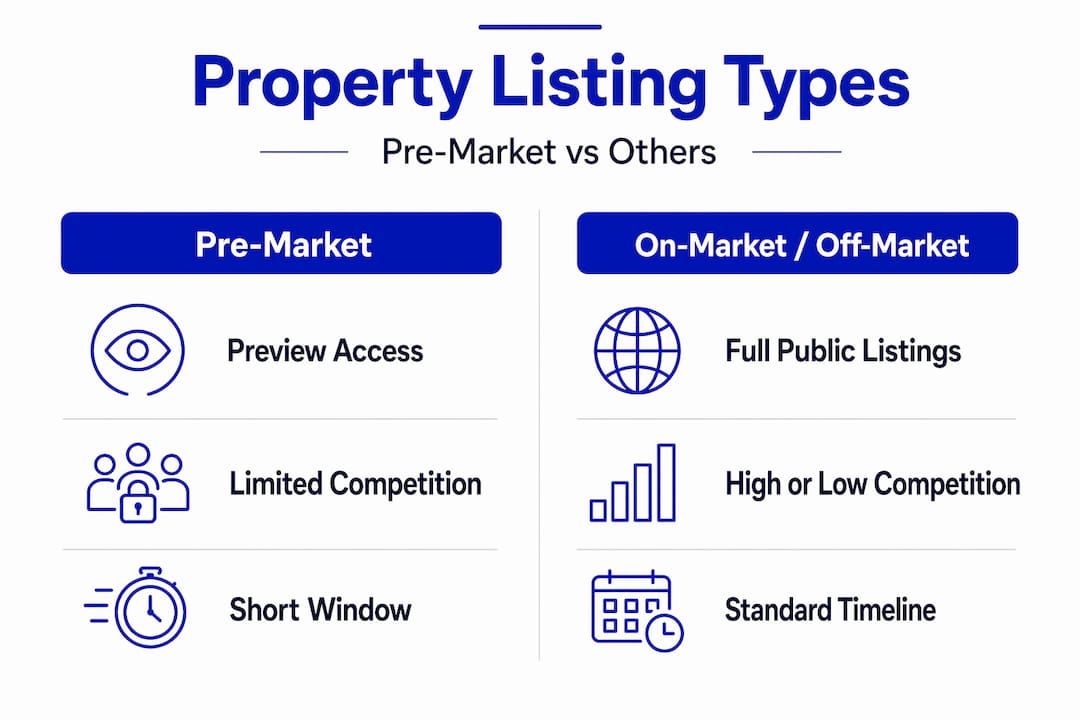
How pre-market compares to on-market and off-market
Not all listing types are created equal. Each carries a different level of visibility, competition, and buyer access. Here is how they stack up:
| Listing type | Visibility | Competition level | Buyer access | Typical deal dynamic |
|---|---|---|---|---|
| On-market | Full MLS and portal exposure | High | Open to all buyers | Multiple offers, market pricing |
| Pre-market | Partial, "coming soon" label | Moderate | Selective, agent-controlled | Early positioning, limited data |
| Off-market | None, private networks only | Low | Relationship-dependent | Negotiated pricing, high trust required |
Pre-market listings act as a middle category between publicly listed on-market and hidden off-market deals, with selective buyer access that gives early movers a real edge. You are not competing with every buyer on Zillow, but you are not flying blind through private networks either.
The practical implication for buyers is this: pre-market gives you time. You can research the property, drive by, study the neighborhood, and prepare your financing before the listing goes live and the bidding wars start. That preparation window is the real value of pre-market access, not some secret discount that sellers hand out to the first person who calls.

What buyers often misunderstand is that online visibility differs from actual rights to tour or submit offers during pre-market. Seeing a property on a portal does not mean you can schedule a showing tomorrow. Local MLS compliance rules determine that, and they vary significantly by market.
How technology is opening pre-market access
The good news for buyers and investors is that pre-market visibility is expanding. In 2026, Homes.com expanded consumer access to pre-market listings, giving buyers early property previews before official sale dates. This move reflects a broader industry shift toward transparency at the early stages of a listing's life.
Andy Florance, CEO of CoStar Group, has emphasized the goal of giving buyers early market visibility while protecting seller control during pre-market phases. That balance matters. Sellers opt in to pre-market display because it generates interest and helps them gauge demand. Buyers benefit because they get more research time and a head start on properties they care about.
Here is what this technology shift means practically for buyers:
- Consumer portals now surface "coming soon" listings with estimated go-live dates
- Buyers can set up alerts for pre-market properties in specific zip codes or price ranges
- Some platforms provide property details, photos, and neighborhood data before active status
- Agents can use portal data to identify pre-market inventory and brief their buyer clients early
The catch is that portal access and MLS compliance are two separate things. Seeing a listing on Homes.com does not mean the local MLS allows showings or offers before the active date. Sellers and agents choose whether to opt into pre-market display, and local rules govern what buyers can actually do once they find those listings.
Pro Tip: Set up saved searches on multiple portals, not just one, and filter specifically for "coming soon" status. Different platforms pull from different data sources, and the one that surfaces a pre-market listing first could give you a 48-hour advantage over buyers using a single portal.
How to find and act on pre-market properties
Finding pre-market deals consistently requires a system, not luck. Here is a practical approach that works in competitive markets:
-
Build relationships with listing agents in your target area. Broker connections are the most reliable source of early deal access. Agents often know about upcoming listings days or weeks before any portal does. If you are a serious buyer or investor, make that known to agents who specialize in your target neighborhoods.
-
Verify your local MLS rules before pursuing any pre-market deal. Local MLS policies affect what buyers can do during pre-market phases, including whether showings are permitted and whether offers can be submitted before active status. Assuming you can act freely during a "coming soon" period is a common mistake that wastes time and damages agent relationships.
-
Prepare your financing before you need it. Pre-market windows are short. If a property goes active and you are still waiting on a pre-approval letter, you have lost the advantage you worked to build. Have your financing documentation current and your lender on standby.
-
Study the property with available data. Limited listing data does not mean no data. Pull public records, tax assessments, permit history, and comparable sales before the listing goes live. Walk the street. Talk to the listing agent about the seller's timeline and motivation.
-
Time your offer strategically. Some sellers accept pre-market offers to avoid the stress of a full public launch. Others use pre-market buzz to build demand before going active. Knowing which situation you are in shapes whether you push for an early offer or wait for the active date.
-
Use signal-based tools to spot properties before they even reach "coming soon" status. Permit filings, code violations, and deferred maintenance patterns often signal that a property is heading toward sale months before any listing appears. This is where early opportunity recognition separates disciplined investors from reactive ones.
Pitfalls and legal considerations
Pre-market real estate is not without risk. The same features that create opportunity also create traps for unprepared buyers.
The biggest misconception is that "coming soon" status means the property is available to tour and offer on immediately. NAR's Clear Cooperation Policy requires public listings to enter MLS within one business day of public marketing, but it allows pre-market activity under local MLS rules. Those rules vary enormously. In some markets, showings during "coming soon" status are prohibited entirely. In others, they are permitted with written consent from the seller.
Watch out for these specific issues:
- Disclosure gaps. Sellers may not have completed all required disclosures during pre-market. You could fall in love with a property before learning about material defects.
- Offer restrictions. Some MLS systems prohibit agents from presenting offers during pre-market periods, meaning your early enthusiasm cannot translate into an early contract.
- Inflated expectations. Pre-market buzz can push a seller toward higher pricing expectations before they have real market feedback. You may find that the "exclusive early access" you got still leads to a bidding war at list price.
- MLS rule violations. Agents who improperly extend pre-market periods or restrict access in ways that violate Clear Cooperation Policy rules can create legal exposure for both themselves and their clients.
Pro Tip: Before engaging seriously with any pre-market property, ask the listing agent directly: "What does your local MLS allow during coming soon status?" A confident, specific answer tells you the agent knows the rules. A vague answer is a red flag worth noting.
My take on pre-market timing
I have watched a lot of buyers chase pre-market properties the wrong way. They treat it like a race to the portal, refreshing listings every hour and calling agents the moment a "coming soon" badge appears. That approach almost never works.
What actually works is being known before the listing exists. In my experience, the buyers who consistently win pre-market deals are the ones agents already trust. They have closed deals without drama. They show up prepared. When an agent has a seller who wants a quiet, clean transaction before going public, they call the buyer they trust, not the one who left three voicemails last week.
The counterintuitive truth is that pre-market advantage is less about access to information and more about reputation. Technology has made pre-market listings more visible to everyone. That visibility has reduced the information gap but not the relationship gap. The buyer who invested six months building agent relationships in their target market still gets the call before the portal alert goes out.
I also think most buyers underestimate how much early distress signals matter. Properties do not decide to sell overnight. The signals show up in permit records, code violations, and deferred maintenance long before any listing appears. Investors who read those signals are not waiting for pre-market. They are creating it.
— Avi
How Getshovld gives you the earliest possible edge

Pre-market listings are valuable. But what if you could identify properties heading toward sale before the seller even calls an agent? That is exactly what Getshovld is built to do. The platform tracks permits, code violations, HOA pressure, distressed-property indicators, and deferred maintenance patterns across U.S. markets, turning scattered public records into scored, verified opportunities.
For real estate investors, this means you are not waiting for a "coming soon" badge to appear on a portal. You are seeing the signals that predict a sale weeks or months earlier. Getshovld's intelligence layer puts you at the front of the pipeline, not the middle.
Explore how Getshovld works to understand the signal types the platform monitors and how they translate into early deal flow. When you are ready to see what it costs to run this kind of intelligence in your market, the pricing plans break down options for investors and real estate professionals at every scale.
FAQ
What is a pre-market property in real estate?
A pre-market property is one that a seller or agent begins marketing before it goes officially active on the MLS, typically under a "coming soon" label. It is distinct from an off-market property, which never appears on the MLS at all.
Can you make an offer on a pre-market listing?
It depends on your local MLS rules. Some markets allow offers during pre-market periods, while others prohibit agents from presenting offers until the listing goes active. Always confirm local policies before assuming you can submit early.
How do pre-market listings benefit buyers?
Pre-market listings give buyers a research and preparation window before a property opens to full competition. Buyers can study the property, arrange financing, and position themselves to move quickly when the listing goes active.
How do you find pre-market properties?
The most reliable methods are building relationships with local listing agents, setting up "coming soon" alerts on multiple consumer portals, and using signal-based platforms that track public records like permits and code violations to identify properties before they list.
Are pre-market listings the same as off-market properties?
No. Pre-market properties are on their way to the MLS and may already be visible on consumer portals under "coming soon" status. Off-market properties are never listed publicly and circulate only through private networks and direct outreach.
Recommended
- Distress Doesn't Start With Foreclosure | Shovld Blog
- The South Florida HOA Crisis: How Property Owners Are Drowning in Repairs While Contractors Miss Opportunities | Shovld Blog
- Shovld | Construction Signal Intelligence Platform
- The Construction Industry Has a Timing Problem: Why Contractors Enter Too Late and Miss 80% of Opportunities | Shovld Blog