
Rental code violations are defined as documented failures to meet municipal housing standards, and their role in portfolio acquisition is one of the most underestimated risk factors in real estate investing. Investors who treat violations as cosmetic issues pay for that mistake at closing, during refinancing, and in court. Cities like New York City and Merced, California have made enforcement impossible to ignore. NYC's Housing Preservation and Development department issued 895,457 violations in FY2024 alone. Merced imposes daily fines up to $1,000 for repeat offenders. That enforcement intensity reshapes every stage of the acquisition process.
How do rental code violations influence property valuation and buyer interest?
Code violations compress both price and buyer demand at the same time. A property with open violations signals deferred maintenance, legal liability, and uncertain carrying costs. Buyers who understand that signal either walk away or discount aggressively.
The financing impact is direct and severe. Conventional lenders block financing for properties with open habitability or safety violations. That restriction pushes the buyer pool toward cash buyers and portfolio lenders, which shrinks competition and drives prices down. For an acquisition-minded investor, that dynamic creates opportunity. For a seller, it creates urgency.

Operational costs also rise before the first rent check arrives. Remediation requires licensed contractors, documented inspections, and permit closures. Many investors underestimate these costs because hidden labor and documentation requirements often cause failed inspections, which delay leasing and push back cash flow timelines.
Key valuation impacts include:
- Price discounts tied to the estimated remediation cost plus a risk premium buyers demand for uncertainty
- Reduced buyer pool because most institutional and conventional financing is unavailable
- Delayed income from leasing holds while violations remain open
- Municipal lien exposure that transfers to the buyer at closing if not resolved before sale
Pro Tip: Pull the full violation history, not just the current open violations. A property with a pattern of recurring violations signals a systemic management problem, not a one-time oversight.
What types of rental code violations most affect portfolio acquisition risk?
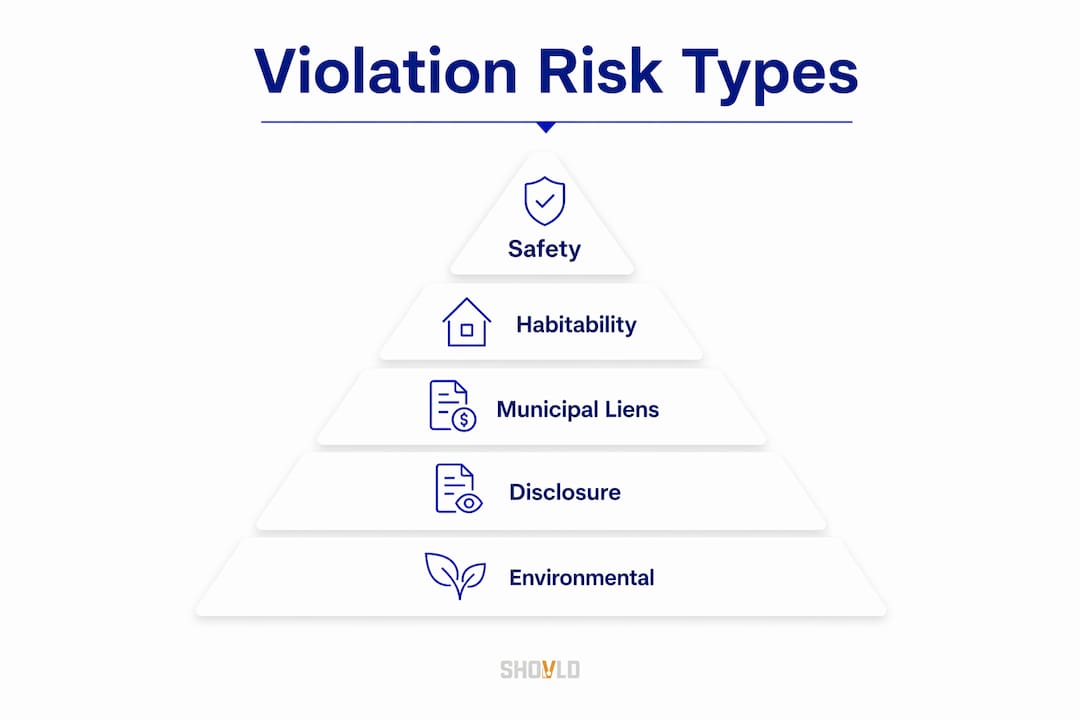
Violations fall into four broad categories, and each carries a different financial consequence for the acquiring investor.
- Habitability violations cover conditions that make a unit unlivable: broken heat, water intrusion, pest infestation, and mold. These are the most common and the most likely to trigger tenant rent withholding or litigation.
- Safety violations include fire egress failures, missing smoke detectors, faulty electrical panels, and structural hazards. These carry the highest liability exposure and the most aggressive municipal penalties.
- Disclosure failures are violations tied to what a seller did not tell you. Landlords who fail to disclose lead-based paint hazards face civil penalties up to $19,507 per violation under 2026 EPA rules. That liability transfers to a buyer who acquires without proper due diligence.
- Open permit violations occur when prior renovation work was never inspected or closed. These create title complications and block refinancing.
| Violation Type | Primary Financial Risk | Typical Resolution Path |
|---|---|---|
| Habitability | Rent withholding, tenant litigation | Licensed repair, re-inspection |
| Safety | Municipal fines, insurance loss | Certified contractor, permit closure |
| Disclosure failure | EPA civil penalties up to $19,507 | Legal disclosure, remediation escrow |
| Open permits | Refinancing blocked, title issues | Permit closure, final inspection |
Municipal liens represent a separate category of risk. When a city performs abatement work because a landlord failed to act, that lien attaches to the property and becomes payable at closing. A buyer who does not identify these liens before signing takes on that cost without any negotiating leverage.
How does intensified municipal enforcement in 2026 change acquisition due diligence?
The enforcement environment has shifted from periodic to persistent. NYC's 895,457 violations in FY2024 reflect a city-wide policy of continuous monitoring, not reactive response. That volume means more properties in any given market carry violation histories that affect financing and insurance.
The refinancing impact is particularly significant for portfolio investors. Open Class B and C violations block refinancing or produce unfavorable loan terms. A single building with unresolved violations can affect lending conditions across an entire portfolio. That is not a property-level problem. It is a portfolio-level problem.
Insurance exposure follows the same pattern. Repeated or severe violations increase premiums and risk coverage loss entirely. An investor who acquires a property with a violation history and does not remediate it quickly may find that their insurer declines renewal at the next policy cycle.
Due diligence now requires a forensic audit approach. Physical inspections catch visible conditions. They do not catch municipal liens and open violations recorded in city databases that have not yet triggered a physical notice. Institutional investors now treat fire safety certifications, electrical inspection reports, and energy compliance certificates as core acquisition requirements, not optional add-ons.
The shift in practice looks like this:
- Title search plus municipal lien search run simultaneously, not sequentially
- Violation database queries covering the prior 5–7 years, not just current open items
- Permit history review to identify work completed without final inspection
- Insurance underwriting review before closing, not after
Pro Tip: Use municipal data tools to query violation histories across multiple properties at once. Running these searches manually on city portals is slow and inconsistent. Aggregated data gives you a pattern view that individual searches miss.
What practical strategies can investors use to manage violation risks during acquisition?
Violation risk management starts before the offer, not after the inspection. Investors who build violation screening into their initial underwriting model avoid the most expensive surprises.
Negotiation is the primary tool for managing known violations. When violations are identified during due diligence, the investor has three options: require the seller to remediate before closing, negotiate a price reduction equal to the estimated remediation cost plus a contingency buffer, or structure an escrow holdback that funds remediation after closing. Each approach has merit depending on the violation type and the seller's motivation. Proper disclosure of known violations is legally required and protects the buyer from post-sale litigation.
Practical strategies for managing violation risk include:
- Pre-offer violation screening using city databases and aggregated public record tools to identify open items before committing due diligence costs
- Remediation cost modeling that includes licensed contractor rates, permit fees, inspection costs, and a contingency for failed re-inspections
- Escrow holdbacks structured to release funds only after municipal sign-off, not after contractor completion
- Tenant liability review to assess whether existing tenants have filed complaints or withheld rent, which signals ongoing habitability disputes
- Professional property management engaged at closing to establish a compliance calendar and prevent new violations from accumulating
Learning how to bid on code violation properties requires understanding the full cost stack before the offer goes in. Investors who skip that step often win the bid and lose the deal.
How do rental code violations affect long-term portfolio performance?
Violations acquired with a property do not disappear at closing. They follow the asset through its entire ownership cycle and affect every major financial event.
Refinancing is the most immediate pressure point. Open violations block conventional refinancing and force investors into higher-cost bridge or portfolio loans. That cost compounds over time and reduces the return on the original acquisition. A property bought at a discount because of violations may deliver no net advantage if the financing cost premium erases the savings.
Insurance renewal is the second pressure point. Carriers review loss histories and inspection records at renewal. A property with a pattern of violations signals deferred maintenance and elevated claim risk. Premiums rise or coverage lapses. Either outcome increases operating cost and reduces net income.
Tenant litigation is the third risk. Open habitability violations give tenants legal standing to withhold rent in most jurisdictions. A single tenant action can freeze rental income for months while the case moves through housing court. The cumulative effect on portfolio cash flow is significant.
| Risk Category | Short-Term Impact | Long-Term Impact |
|---|---|---|
| Refinancing | Blocked or high-cost loans | Reduced portfolio leverage capacity |
| Insurance | Premium increases | Coverage loss, higher operating cost |
| Tenant litigation | Rent withholding, legal fees | Reputation damage, vacancy increases |
| Asset value | Acquisition discount | Compressed exit price if violations persist |
Early-stage compliance investment protects asset value across all four categories. Investors who remediate violations within the first 90 days of ownership reset the property's compliance record and restore full financing and insurance options.
Key takeaways
Rental code violations are a quantifiable acquisition risk, and investors who build violation audits into standard due diligence protect both purchase price and long-term portfolio returns.
| Point | Details |
|---|---|
| Violations compress buyer pools | Open violations push most lenders out, leaving only cash and portfolio buyers to set price. |
| Forensic audits are required | Physical inspections miss municipal liens and database violations that block refinancing. |
| Disclosure failures carry EPA penalties | Undisclosed lead hazards trigger civil penalties up to $19,507 per violation under 2026 rules. |
| Enforcement volume is rising | NYC issued 895,457 violations in FY2024, signaling persistent municipal monitoring across markets. |
| Early remediation protects returns | Resolving violations within 90 days of closing restores financing options and prevents insurance loss. |
A field perspective on violation risk in acquisitions
Violation-affected properties are where I see the sharpest divide between investors who do this well and those who get burned. The investors who struggle treat violations as a negotiation footnote. They get a price reduction, close, and then discover that the remediation cost was twice the estimate, the permits were never closed, and the lender will not refinance until everything is resolved.
The investors who profit from violation-heavy acquisitions treat the violation record as a research project. They pull five years of history. They cross-reference open permits with the violation log. They call the city inspector's office directly to understand what sign-off actually requires. That level of preparation is not common, which is exactly why it creates an edge.
The 2026 enforcement environment makes this discipline non-negotiable. Cities are not pulling back. They are adding staff, increasing fine schedules, and publishing violation data in formats that make it easier for tenants and advocacy groups to act on. An investor who is not tracking permit and violation data systematically is flying blind in a market that rewards early visibility.
The opportunity is real. Violation-burdened properties trade at discounts because most buyers cannot or will not do the work to understand the true cost. Investors who can model that cost accurately and remediate efficiently will continue to find acquisitions that perform well. The ones who skip the audit step will keep learning the same expensive lesson.
— Avi
How Shovld supports violation-aware portfolio acquisition
Real estate investors who track code violations manually spend hours on city portals pulling incomplete records across multiple jurisdictions. Shovld aggregates permit data, code violation records, municipal liens, and distressed-property signals across U.S. markets into a single scored feed.

Shovld's AI-powered platform identifies properties with open violations, patterns of repeat enforcement, and deferred maintenance signals before those properties hit the market. That early visibility gives investors time to model remediation costs, structure offers, and move before the deal becomes crowded. For investors building or expanding a portfolio in 2026, the platform's signal intelligence plans provide the data infrastructure that manual research cannot match.
FAQ
What is the role of rental code violations in portfolio acquisition?
Rental code violations directly affect acquisition pricing, financing availability, and post-closing operational costs. Investors must audit violation histories before closing to avoid inheriting liens, blocked refinancing, and tenant liability.
How do code violations affect property financing?
Conventional lenders require habitability and code compliance at closing. Open violations push the buyer pool to cash buyers and portfolio lenders, which reduces competition and compresses sale prices.
What violation types carry the highest financial risk for investors?
Disclosure failures and safety violations carry the highest penalties. Undisclosed lead-based paint hazards trigger EPA civil penalties up to $19,507 per violation, and safety violations can result in insurance cancellation and municipal fines.
How does a violation history affect refinancing after acquisition?
Open Class B and C violations block conventional refinancing and force investors into higher-cost loan products. A single unresolved violation in a portfolio can affect lending terms across multiple properties.
What due diligence steps protect investors from violation-related losses?
Investors need a municipal lien search, a 5–7 year violation history query, and a permit closure review run before closing. Physical inspections alone do not surface database violations or unresolved liens.