
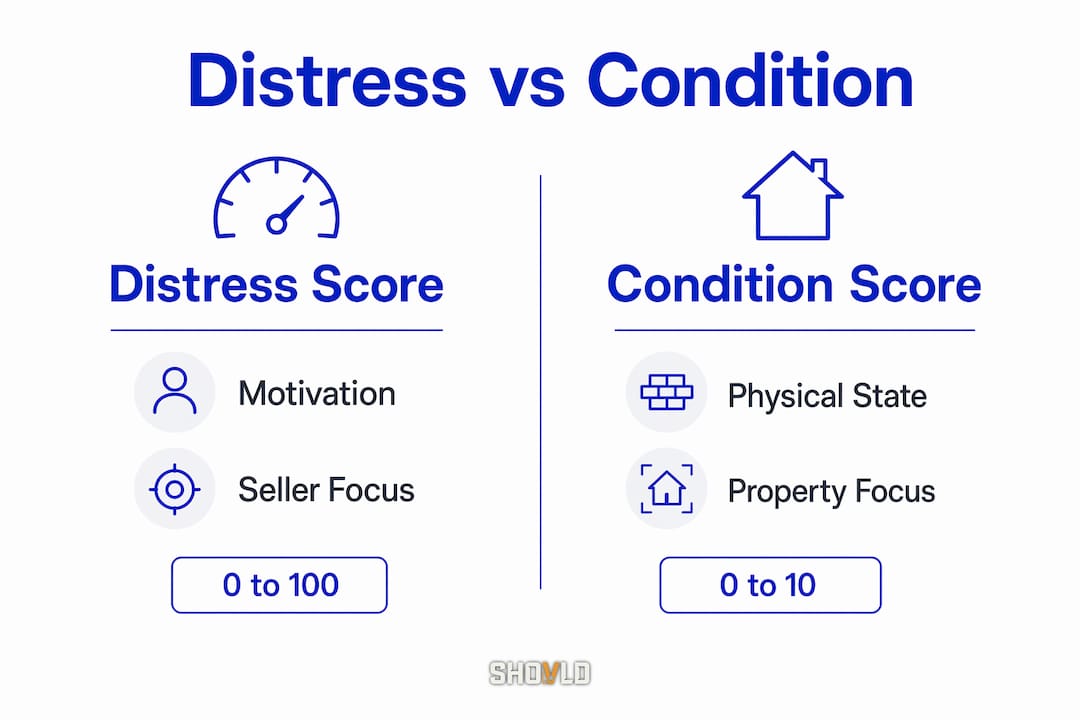
A property distress score is a numerical metric that estimates how likely a property owner is motivated to sell under financial, legal, or situational pressure. This probabilistic measure helps real estate investors and agents identify potential negotiation opportunities before a property ever hits the open market. Unlike a property condition score, which evaluates physical state and repair costs, a distress score focuses entirely on seller motivation. Signals like tax delinquency, pre-foreclosure status, probate, code violations, and vacancy feed into a weighted model that produces a single, actionable number. Understanding what is a property distress score gives professionals a real edge in lead prioritization and deal sourcing.
What is a property distress score and how is it calculated?
A property distress score ranges from 0 to 100 on a standard scale, or 0 to 10 on a weighted scale, and quantifies the likelihood of seller motivation due to financial, legal, or situational distress. Scores above 50 on the 100-point scale, or above 5 on the weighted scale, flag properties where owners are statistically more likely to accept below-market offers. The higher the score, the stronger the signal.
The calculation uses a weighted sum model. Each distress signal carries a specific weight based on its urgency and financial impact. Tax delinquency and pre-foreclosure each carry a weight of 3.0, reflecting their time-sensitive financial pressure. Probate carries a weight of 2.0, while code violations and vacancy each carry 1.5. These weights reflect how directly each signal correlates with a motivated seller.

Owner occupancy status acts as a multiplier on top of the base score. Absentee owners increase distress scores by roughly 1.3x, because non-occupying owners face fewer emotional barriers to selling quickly. A property with a base score of 6.0 held by an absentee owner effectively signals at 7.8, pushing it firmly into high-priority territory.
Multiple signals stack synergistically. A property showing tax delinquency, a code violation, and vacancy simultaneously does not simply add those weights together in isolation. The combination signals a pattern of neglect and financial strain that compounds the probability of seller motivation. This is why combining multiple distress signals with owner occupancy multipliers creates a more powerful lead priority signal than any single indicator alone.
| Signal | Weight | Notes |
|---|---|---|
| Tax delinquency | 3.0 | Highest urgency; time-sensitive financial pressure |
| Pre-foreclosure | 3.0 | Legal deadline creates strong sell motivation |
| Probate | 2.0 | Estate liquidation often drives flexible pricing |
| Code violations | 1.5 | Signals deferred maintenance and financial strain |
| Vacancy | 1.5 | Carrying costs without income increase sell pressure |
| Absentee ownership | 1.3x multiplier | Applied to base score; increases overall priority |
Pro Tip: When reviewing a lead list, filter first for properties with two or more overlapping signals. A single code violation is noise. Tax delinquency plus vacancy plus absentee ownership is a pattern worth calling.
How does a distress score differ from a property condition score?
A property condition score measures the physical state of a property, not the motivation of its owner. Models like the Veros Home Score use AI and computer vision to assess physical condition on scales like 1.0–5.0 or C1–C6, and they can improve property valuation accuracy by more than 5%. These scores help estimate rehab costs and flag deferred maintenance before a physical visit.
A distress score answers a completely different question. It does not tell you whether the roof needs replacing. It tells you whether the owner is under enough pressure to negotiate seriously. A property in excellent physical condition can carry a high distress score if the owner is navigating probate, facing tax liens, or carrying a vacant rental with no income. The physical and motivational signals are independent of each other.
| Dimension | Distress score | Condition score |
|---|---|---|
| Primary question | Is the owner motivated to sell? | What is the physical state of the property? |
| Key inputs | Tax delinquency, pre-foreclosure, probate, vacancy | Structural condition, age, repairs, maintenance |
| Output | Seller motivation probability | Valuation adjustment and rehab cost estimate |
| Best use | Lead prioritization and negotiation targeting | Offer pricing and renovation budgeting |
| Limitation | Does not reflect physical property state | Does not reflect seller motivation |
The most effective property risk evaluation uses both scores together. A high distress score identifies who to call. A condition score tells you what the deal is actually worth once you get them on the phone. Skipping either one creates blind spots that cost money.
Pro Tip: Request a condition assessment or drive-by inspection before making an offer on any high-distress-score property. The distress score got you to the door. The condition score tells you what to offer.
How do real estate professionals use distress scores in acquisitions?
Distress scores give investors and agents a way to prioritize leads before spending time on outreach. Instead of cold-calling every absentee owner in a zip code, professionals focus on the top-scored properties where the probability of a productive conversation is highest. This shift from volume-based prospecting to signal-based targeting changes the economics of deal sourcing entirely.
Negotiation strategy also changes when you know the score. A property with a score above 70 on the 100-point scale signals meaningful pricing flexibility. A strategic offer on a high-distress property typically targets a negotiation margin of 5–10% below asking price. Going too far below market value risks rejection even when the seller is under pressure, because sellers still have a floor tied to their outstanding obligations.
Distress scores also improve workflow efficiency for wholesalers and fix-and-flip investors. Modern scoring tools aggregate public distress signals, deduplicate records, and calculate composite scores for targeted outreach. This means a wholesaler can build a prioritized call list in minutes rather than spending days pulling county records manually.
Here is how professionals integrate distress scores into a practical acquisition workflow:
- Lead filtering: Pull all properties above a defined score threshold (e.g., 50+ on the 100-point scale) in a target market.
- Signal review: Check which specific signals drove the score. Tax delinquency and pre-foreclosure require faster follow-up than vacancy alone.
- Owner profile check: Confirm absentee ownership status. Absentee owners are statistically more likely to engage quickly.
- Outreach sequencing: Contact high-score leads first. Use automated follow-up for mid-range scores to maintain pipeline without manual effort.
- Due diligence gate: Before making an offer, run a title search and assess physical condition. The score opened the door; due diligence closes the deal.
Shovld tracks distressed property indicators across multiple U.S. markets, combining permit data, code violations, tax records, and ownership signals into verified, scored opportunities. Investors using Shovld can act on distress signals before the property reaches a crowded auction or gets picked up by competing buyers.
Pro Tip: Set a calendar reminder to re-score your pipeline every 30 days. Distress signals evolve. A property that scored 45 last month may score 70 today if a tax lien was filed or a code violation escalated.
What are the key limitations of relying on property distress scores?
Distress scores are probabilistic, not predictive. A score of 80 does not guarantee the owner will sell. It means the combination of signals present on that property statistically correlates with motivated seller behavior. The owner may have already resolved the tax lien, found a private buyer, or simply decided not to sell. Treating a high score as a certainty leads to wasted outreach and misallocated capital.
Distress also exists on a spectrum from early to late stages. Early-stage distress offers structured resolution opportunities, where investors can negotiate directly with owners who still have options. Late-stage distress, such as REO status or active foreclosure auction, involves competitive bidding and less room for direct negotiation. Recognizing the stage early is what separates a manageable opportunity from a crisis situation.
"Distress scores should be treated as probabilistic signals rather than absolute truths, useful for building lead funnels but not replacing due diligence. Experts recommend using scores to funnel leads, not as shortcuts to skip steps like title searches or direct property assessment."
A high distress score also says nothing about investment quality. A property can score 90 because the owner is navigating probate on a well-maintained, fully occupied rental. The financial pressure is real, but the asset itself may be worth full market value. Investors who conflate seller motivation with poor fundamentals miss strong deals and misread their own risk exposure.
The right mental model treats distress scores as the top of a funnel, not the bottom. They narrow a large universe of properties down to a shortlist worth investigating. Every property on that shortlist still requires a title search, a physical assessment, and a direct conversation with the owner before any capital moves.
Key Takeaways
A property distress score is a weighted, probabilistic metric that identifies motivated sellers, not property quality, making it a lead-generation tool that requires due diligence to convert into closed deals.
| Point | Details |
|---|---|
| Distress score definition | Scores range from 0 to 100 and estimate seller motivation based on financial and legal signals. |
| Top-weighted signals | Tax delinquency and pre-foreclosure carry the highest weights (3.0 each) due to financial urgency. |
| Distress vs. condition | Distress scores measure seller motivation; condition scores measure physical property state. |
| Absentee ownership multiplier | Absentee ownership increases a base distress score by roughly 1.3x, raising lead priority. |
| Scores are a funnel, not a verdict | Use distress scores to prioritize outreach, then validate every lead with title research and inspection. |
Why I think most investors misread distress scores
The most common mistake I see is treating a high distress score as a green light to make a low offer without doing the work. Investors see a score of 75, assume the seller is desperate, and go in 20% below market. The seller walks. The deal dies. The investor blames the score.
The score did its job. It identified a motivated seller. The investor skipped the step where you figure out why the seller is motivated and what their actual floor is. A probate situation looks identical to a tax delinquency in the score, but the negotiation dynamics are completely different.
What I have found works is using the score to decide who to call, then using the conversation to understand the situation. The score gets you to the right door. The conversation tells you how to open it.
Scoring methodologies are also getting sharper. Advanced scoring models now integrate AI-driven analytics and emerging data sources to improve prediction accuracy continuously. The professionals who will win in 2026 are the ones who treat these tools as a starting point for smarter outreach, not a substitute for the work that closes deals.
— Avi
How Shovld turns distress signals into verified leads
Real estate investors and agents who want to act on distress scores before the market catches up need more than a spreadsheet of public records.

Shovld aggregates permits, code violations, tax delinquency records, HOA pressure signals, and ownership data across multiple U.S. markets into a single scored opportunity feed. Every lead arrives verified and ranked, so your team focuses on the highest-probability properties first. Shovld's AI-powered follow-up automation keeps your pipeline moving without manual effort. Explore Shovld's signal intelligence plans to see which tier fits your market and deal volume.
FAQ
What is a property distress score used for?
A property distress score is used to identify motivated sellers and prioritize leads for real estate investors and agents. It ranks properties by the likelihood that the owner will accept a below-market offer due to financial or situational pressure.
What signals contribute most to a high distress score?
Tax delinquency and pre-foreclosure carry the highest weights in most scoring models, each assigned a weight of 3.0. Probate, code violations, and vacancy also contribute, and absentee ownership applies a 1.3x multiplier to the base score.
Does a high distress score mean the property is in poor condition?
No. A high distress score reflects seller motivation, not physical property state. A well-maintained property can score high due to probate or tax liens, which is why condition assessments must be done separately.
How should investors act on a high distress score?
Investors should use the score to prioritize outreach, then run a title search and physical assessment before making an offer. A strategic offer on a high-distress property typically targets 5–10% below asking price, balancing seller pressure with market value.
How is a distress score different from a property condition score?
A distress score measures the probability that an owner is motivated to sell under pressure. A property condition score, such as the Veros Home Score, measures the physical state of the property and supports valuation accuracy and rehab cost estimation.