
A scored investment opportunity is defined as a potential investment evaluated through predefined, weighted criteria that produce a numerical score for comparison and decision-making. The industry term for this practice is opportunity scoring or investment scoring, and it sits at the center of modern portfolio selection. Scoring frameworks typically use scales of 1–100 or 0–10 to standardize comparisons across deals. Three core buckets drive every credible model: strategic fit, risk and feasibility, and economic returns. For investors and financial professionals who need to move fast and move right, understanding scored investment opportunities is the difference between a disciplined pipeline and a crowded guessing game.
What is a scored investment opportunity, and how does it work?
A scored investment opportunity converts subjective judgment into a repeatable number. Each deal gets rated across a set of weighted criteria, and the total score reflects how well that deal aligns with your investment thesis. Most scoring frameworks use either a 1–100 scale or a 0–10 scale, depending on the granularity the investor needs.
The three core buckets are not interchangeable. Strategic fit measures whether the deal matches your mandate, sector focus, and portfolio goals. Risk and feasibility covers execution risk, market conditions, regulatory exposure, and team capability. Economic returns capture projected IRR, cash-on-cash yield, payback period, and margin expectations. Each bucket carries a weight, and those weights reflect your priorities as an investor.

Effective scoring models use 8–12 specific, measurable criteria across these three buckets. That range balances depth with usability. Fewer than eight criteria and you miss material risk factors. More than twelve and interpretation slows down, which defeats the purpose.
Pro Tip: Before you build a model, write down the five questions you always ask yourself before saying yes to a deal. Those questions are your first five criteria.
What are the common criteria and scoring models used for investment evaluation?
The criteria inside each bucket determine whether a model actually predicts outcomes or just creates the appearance of rigor. Predictive, measurable, and decision-relevant criteria are the standard. Generic criteria like "market attractiveness" without a measurable definition produce noise, not signal.
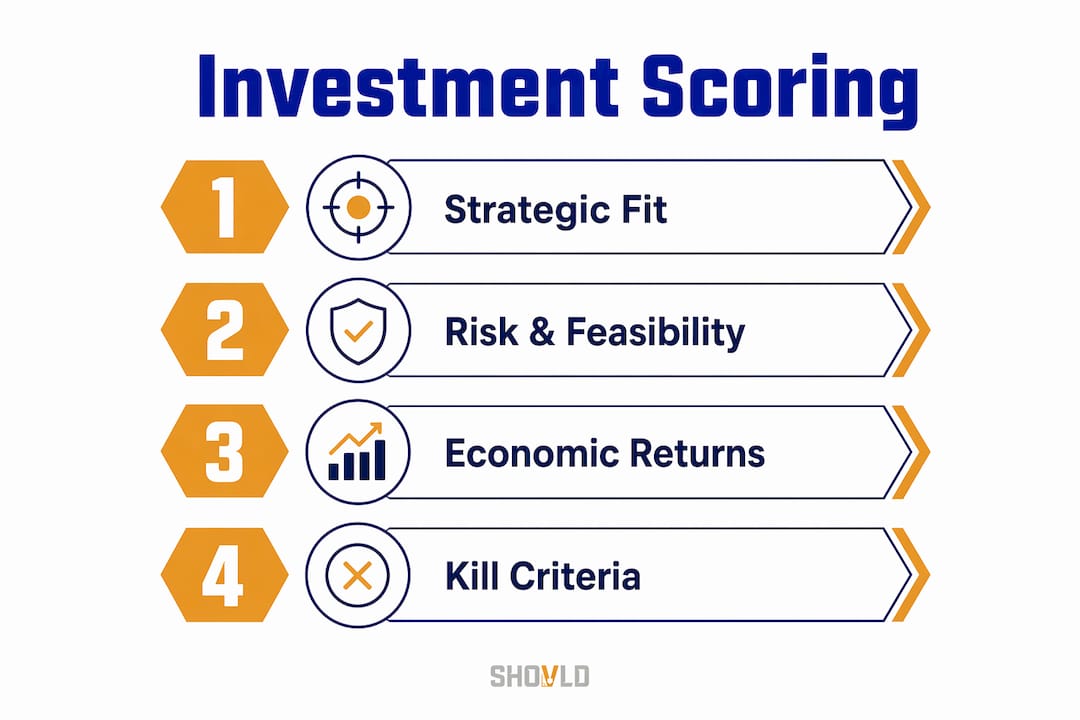
Common criteria within the three buckets include:
Strategic fit
- Alignment with sector thesis
- Geographic fit
- Portfolio diversification impact
- Operator or sponsor track record
Risk and feasibility
- Regulatory and permitting risk
- Execution complexity
- Market liquidity and exit options
- Leverage and debt coverage ratios
Economic returns
- Projected IRR or ROI
- Cash yield and payback period
- Downside scenario performance
- Comparable transaction benchmarks
Kruncher's deal scoring system scores investments on a 1–100 scale that reflects alignment with an investor's specific thesis, automating consistent prioritization across a high-volume pipeline. That kind of personalized logic builds pattern recognition over time. NuScore v5.5 takes transparency further, using 42 or more features with weights that adapt by investment stage, showing exactly which factors drove the score up or down.
Weighting is where most models either earn their keep or fall apart. A 30% weight on economic returns and a 10% weight on execution risk tells a very different story than the reverse. Weights must reflect your actual mandate, not an idealized version of it.
Pro Tip: Run your last five closed deals through your new scoring model before you use it on live opportunities. If the scores don't match your actual outcomes, your weights are wrong.
How does scoring improve investment decision-making compared to traditional methods?
Traditional investment screening relies on gut feel, binary pass/fail filters, or informal checklists. Those methods work for experienced investors on familiar deal types. They fail when volume increases, when team members disagree, or when you need to compare a multifamily deal against a ground-up construction project.
Structured scoring frameworks transform investment selection from an art into a measurable, repeatable process. That shift matters most when you are evaluating ten or more deals per month. A score gives every team member a shared language for why a deal advances or gets cut.
Scoring also reduces cognitive bias. Anchoring bias, recency bias, and familiarity bias all distort judgment when criteria are implicit. When criteria are explicit and weighted in advance, the model holds the line even when a deal feels exciting. The score does not replace judgment. It disciplines it.
The numbered benefits of scoring over traditional methods are clear:
- Consistency. Every deal gets evaluated against the same criteria, regardless of who reviews it.
- Comparability. A 72 out of 100 on a construction deal can be compared directly to a 68 on a SaaS investment if the model is calibrated correctly.
- Documentation. Scores create a record of assumptions that you can review after the investment closes.
- Speed. A scored pipeline cuts the time spent on deals that should have been disqualified in the first screen.
- Learning. When outcomes diverge from scores, you know exactly which criteria to recalibrate.
"The score is mainly a communication tool. It forces you to express your assumptions explicitly and gives you something concrete to revisit when reality diverges from your thesis. The real value is not the number. It is the discipline of writing down what you believed and why."
Angel investor framework, NTU TEC
What are best practices and common pitfalls in building and using investment scoring models?
The most common mistake in scoring model design is adding too many criteria. Metric creep turns a useful tool into a compliance exercise. Models with more than twelve criteria produce false precision and slow every review cycle. Start with 3–9 categories and add complexity only when a new criterion demonstrably improves prediction accuracy.
Kill criteria are non-negotiable. A kill criterion instantly disqualifies a deal regardless of its total score. Examples include minimum ROI thresholds not met, leverage ratios above your mandate ceiling, or regulatory exposure in a prohibited jurisdiction. Without kill criteria, a deal that scores well on economics but fails on fundamental risk can slip through the screen. That is the trap.
Stakeholder disagreement over weights is not a problem to avoid. It is a diagnostic signal. When two partners argue about whether execution risk should carry 20% or 35%, they are actually surfacing a disagreement about the fund's mandate. Resolve that disagreement before you finalize the model, not after.
| Best practice | Common pitfall |
|---|---|
| Use 8–12 measurable criteria | Adding 20+ criteria causes false precision |
| Define kill criteria before scoring | High-scoring deals with fatal flaws advance |
| Align weights with your mandate | Weights reflect aspiration, not actual priorities |
| Review scores against outcomes quarterly | Model never improves after initial build |
| Keep criteria definitions written and shared | Different reviewers interpret criteria differently |
Pro Tip: Assign one person to own the scoring model. Shared ownership means no one updates it when it stops predicting well.
How can scored investment opportunities be applied across different stages and sectors?
Scoring adapts to the investment type, but the underlying logic stays the same. The criteria change. The weights shift. The scale stays consistent so you can compare across a portfolio.
For early-stage startups, the Scorecard Method uses weighted qualitative factors to adjust pre-revenue valuations against regional deal benchmarks. Team strength, market size, and product differentiation carry the most weight at seed stage because financial metrics do not yet exist. The model compensates for the absence of hard data by weighting execution indicators more heavily.
For SaaS venture investors, scoring models combine financial metrics like Rule of 40 and CAC payback with qualitative factors like technology significance and market size. That combination reflects the dual nature of SaaS risk: financial performance and competitive moat matter equally.
For construction and real estate investments, scoring criteria shift toward permitting risk, contractor capacity, local market absorption rates, and distressed property indicators. These deals carry execution risk that financial models alone cannot capture. A property with strong projected returns but active code violations and a contested title scores very differently than one with clean records.
Scoring also drives portfolio prioritization. When you have twenty active opportunities and capacity for four, a scored pipeline tells you which four deserve your time. Without scores, that decision defaults to whoever lobbied hardest in the last meeting.
- Early-stage: Weight team, market size, and differentiation heavily. Financial criteria are secondary.
- Growth equity: Balance revenue metrics, retention, and competitive position equally.
- Real estate and construction: Prioritize execution risk, permitting status, and exit liquidity.
- Distressed assets: Weight downside scenario performance and time-to-resolution above projected upside.
Key takeaways
A scored investment opportunity is the most reliable method for comparing deals consistently, reducing bias, and building a pipeline that reflects your actual investment mandate.
| Point | Details |
|---|---|
| Core scoring buckets | Every model covers strategic fit, risk and feasibility, and economic returns. |
| Optimal criteria count | Use 8–12 criteria to balance depth with usability and avoid metric creep. |
| Kill criteria are mandatory | Non-negotiables must disqualify deals regardless of total score. |
| Weights reveal priorities | Misaligned weights signal mandate confusion that must be resolved before use. |
| Scores enable learning | Reviewing scores against outcomes quarterly improves model accuracy over time. |
Why I think most investors are using scoring wrong
The debate about investment scoring usually centers on which criteria to include. That is the wrong debate. The real question is whether you are using the score as a decision-maker or as a decision-documenter. Those are completely different functions.
I have watched investment teams build detailed scoring models and then override them constantly because a deal "felt right." That behavior does not mean scoring failed. It means the team never agreed on what the score was supposed to do. If the score is a gate, overrides should be rare and documented. If the score is a communication tool, overrides are expected and the discussion around them is the point.
The most underrated benefit of scoring is what happens after a deal closes. When you have a written record of what you believed at entry, you can compare it to what actually happened. That comparison is where real investment judgment develops. Investors who skip scoring skip that feedback loop entirely.
AI-assisted scoring is changing the speed of this process. Platforms that pull public-record signals, permit data, and distressed-property indicators can score opportunities before a human analyst even opens a file. That is not a replacement for judgment. It is early visibility into which deals deserve judgment. The investors who will outperform in the next five years are the ones who treat scoring as a learning system, not a checkbox.
— Avi
How Shovld scores opportunities before the market moves

Shovld is an AI-powered signal intelligence platform built for contractors, real estate investors, restoration companies, and public adjusters who need scored opportunities before the competition arrives. The platform tracks permits, code violations, HOA pressure, deferred maintenance patterns, and municipal records across U.S. markets, then converts that raw signal data into verified, scored property leads that reflect real risk and real opportunity. Every lead comes with a score that reflects strategic fit, execution risk, and economic potential, so your team spends time on deals that match your mandate, not on manual screening. Shovld's CRM and follow-up automation keep your pipeline moving without adding headcount. Review Shovld's pricing plans to see which tier fits your market and volume.
FAQ
What is a scored investment opportunity?
A scored investment opportunity is a potential investment rated through predefined, weighted criteria that produce a numerical score, typically on a 1–100 or 0–10 scale, to support consistent decision-making.
What criteria are used in investment scoring models?
Effective models use 8–12 criteria across three buckets: strategic fit, risk and feasibility, and economic returns, with each criterion weighted to reflect the investor's mandate.
What is a kill criterion in investment scoring?
A kill criterion is a threshold that disqualifies a deal immediately, regardless of its total score. Common examples include minimum ROI not met or leverage ratios above the fund's ceiling.
How does the Scorecard Method apply scoring to startups?
The Scorecard Method uses weighted qualitative factors to adjust pre-revenue valuations against regional benchmarks, placing the highest weight on team strength, market size, and product differentiation at seed stage.
Can scoring models be used across different asset classes?
Scoring models apply across asset classes by adjusting criteria and weights to reflect sector-specific risks. A real estate model weights permitting and execution risk heavily, while a SaaS model prioritizes retention metrics and competitive moat.