
A property's permit history is the single most reliable indicator of its physical condition and risk profile. Every major structural, electrical, or plumbing job that went through the official permit process was reviewed by a licensed inspector and confirmed to meet local building codes. Work that skipped that process? Nobody verified it. That gap is where hidden hazards live.
Permit records function as a documented maintenance trail. They tell you what was done, when it was done, who did it, and whether it passed inspection. Homes with recent permits show significantly fewer inspection issues and lower insurance loss ratios than comparable properties with no permit activity in over a decade. For buyers, investors, and insurers alike, that paper trail is the closest thing to a verified condition report you can get before closing.
The key permit types worth tracking include:
- Structural permits: additions, foundation work, load-bearing modifications
- Electrical permits: panel upgrades, rewiring, EV charger installations
- Plumbing permits: water heater replacements, sewer line work, bathroom additions
- Mechanical permits: HVAC system replacements or major modifications
- Roofing permits: full replacements or significant repairs in jurisdictions that require them
Each of these signals a major system intervention. A permitted roof replacement tells you the work was inspected. An unpermitted one tells you nothing except that someone did something to the roof.
Why permit history predicts property condition

Permits exist because building departments at the state, local, tribal, and territorial level are responsible for adopting and enforcing building codes through an application, permit, and inspection process for new construction and remodel work. That process is not bureaucratic overhead. It is the mechanism that guarantees a third party confirmed the work was done correctly.

Licensed contractors must obtain permits for covered work. When a permit is absent, the most likely explanation is that the work was done by an unlicensed contractor or a homeowner who skipped the process entirely. Neither scenario comes with any verification that the work met code. For a buyer or investor, that absence is a direct signal that the property carries unverified risk.
Insurers have recognized this for years. Permit history gives underwriters a more reliable picture of property risk than property age alone, and permit presence improves risk assessment in ways that age-based models simply cannot replicate. A 1960s home with a fully permitted electrical upgrade and a recent permitted roof is a fundamentally different risk than a 1960s home with no permit activity in 30 years.
How to find and research a property's permit history
Pulling permit records is more straightforward than most buyers realize. Here is a practical sequence that works across most U.S. markets.
-
Start with the local building department website. Most municipalities publish permit records online, searchable by property address. Cities like Seattle maintain dedicated project and permit research portals where you can pull the full permit history for any parcel.
-
Search by parcel number if address searches return incomplete results. County assessor and GIS portals often index permit data by parcel ID. King County, Washington, for example, maintains a parcel viewer that links directly to property records and permit history.
-
Note what each record includes. A complete permit entry typically shows the permit type, issue date, contractor name and license number, inspection dates, and whether a final approval was granted. Missing any of those fields is itself informative.
-
Flag open or expired permits immediately. An open permit means the work was started but never received final inspection sign-off. Expired permits often signal uncompleted or failed inspections, which leaves the owner holding liability for work that was never confirmed compliant.
-
Cross-reference with the county recorder's office. Major additions or accessory dwelling units sometimes appear in deed records or survey filings even when permit records are sparse. County archives can fill gaps that the building department database misses.
-
Verify contractor license status. Most state contractor licensing boards maintain searchable databases. If a permit lists a contractor whose license was suspended or expired at the time of the work, that is a red flag worth investigating before closing.
-
Request records directly from the building department when online data is incomplete. Many older permits predate digital record-keeping. A written public records request to the local building department can surface paper files, inspection cards, and plan sets that never made it into the online system.
-
Hire a permit research professional for complex properties. Commercial properties, multi-family buildings, and older homes with extensive renovation histories often warrant a dedicated permit audit. Title companies and real estate attorneys can coordinate this, and some markets have specialists who do nothing but permit research.
Pro Tip: When you find a gap in permit history covering a period when the property clearly had work done, treat it the same way you would treat a gap in a contractor's references. The absence of documentation is itself a data point.
Common risks tied to unpermitted work
Unpermitted work is not just a paperwork problem. The consequences range from safety hazards to financial losses that can follow a buyer for years after closing.
-
Electrical fires and system failures. Unpermitted electrical work is one of the leading causes of residential fires. Without an inspection, there is no confirmation that wiring was installed correctly, circuits are properly sized, or connections are secure. Home inspectors cannot reliably detect unpermitted work behind walls, which means the hazard stays hidden until something fails.
-
Insurance claim denials. Insurance companies void claims when unpermitted alterations are involved in a loss. A homeowner who had an unpermitted electrical panel upgrade and then files a fire claim may find the insurer denying coverage on the grounds that the alteration contributed to the loss.
-
Loan denial and financing complications. Lenders routinely require retroactive permits before approving financing on properties with known unpermitted work. In some cases, the cost of bringing the work up to current code exceeds the value of the improvement itself.
-
Forced demolition of non-legalizable work. Certain unpermitted projects cannot be legalized because they violate current setback or zoning rules. When that happens, the only remedy is removal, at the owner's expense.
-
Depressed appraisal values. Unpermitted square footage typically cannot be counted in the appraised living area. An unpermitted addition that a seller marketed as 400 additional square feet may contribute nothing to the appraised value, creating a gap between purchase price and appraised value.
-
Negotiation leverage for buyers. Discovered before closing, unpermitted work gives buyers a concrete basis for price reductions or seller-funded remediation. The cost to retroactively permit and correct substandard work is quantifiable, and sellers who want to close have strong incentive to negotiate.
-
Self-pulled permits and DIY liability. Homeowners can legally pull permits for their own work in many jurisdictions. When they do, they assume full liability for the quality of that work. A self-pulled permit with a failed inspection that was never corrected is often worse than no permit at all, because it documents that the work was flagged as non-compliant.
What permit data trends reveal about property risk
The insurance industry has been sitting on a powerful dataset for years and only recently started using it consistently. Permit history is often underutilized by insurers despite its strong predictive power for property losses and inspection prioritization. The properties that generate the most claims are frequently the ones with the longest gaps in documented permit activity.
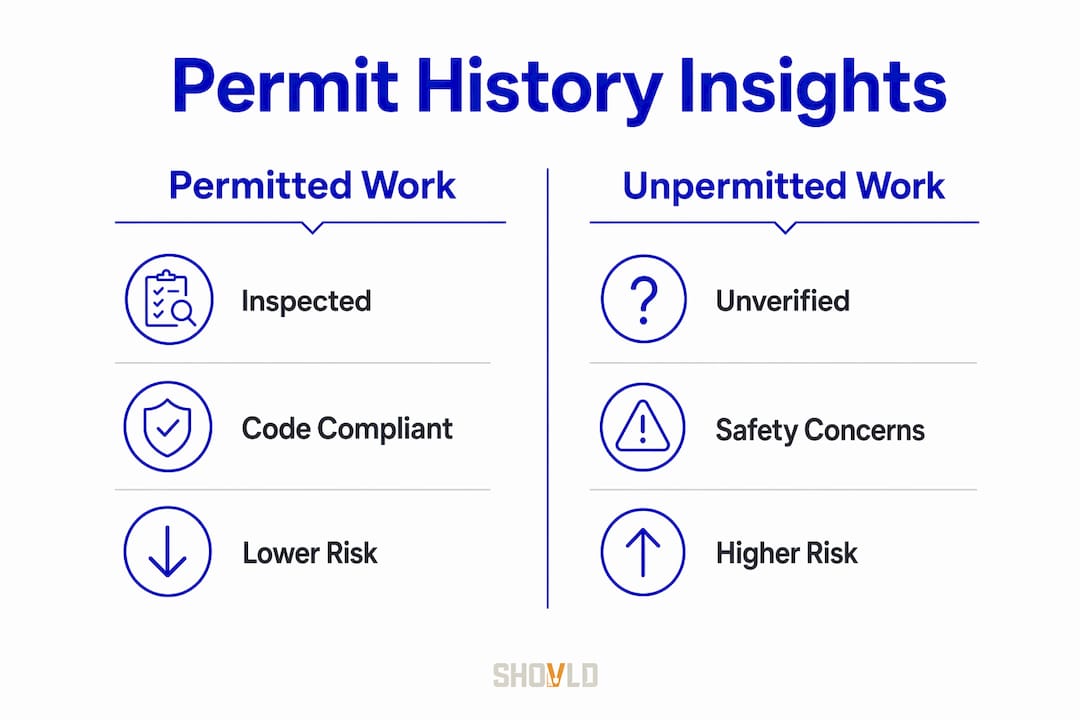
Property age alone is a decreasingly reliable risk indicator. A well-maintained 1950s bungalow with permitted electrical, plumbing, and HVAC upgrades carries a fundamentally different risk profile than a 2005 build with no documented repairs. Underwriters who rely on year-built data without layering in permit history are working with an incomplete picture.
The market-level data reinforces this. A 3-month acceleration in permit approvals within a 22-month construction cycle raises construction spending by 5.7%. That correlation reflects how permit activity functions as a leading indicator of housing stock quality and investment in the built environment. Markets with active permit pipelines tend to have better-maintained housing stock overall, not just in new construction.
For professionals who track permit data at scale, this creates a practical intelligence advantage. Shovld monitors permit activity, code violations, and distressed-property indicators across multiple U.S. markets, translating that raw signal data into scored investment opportunities that surface before the broader market catches on. The permit record is not just a risk filter. It is an early-stage opportunity signal.
Key considerations when interpreting permit history before you buy
Pulling the permit history is step one. Knowing what to do with it is where most buyers and investors fall short.
-
Always verify the final inspection and certificate of occupancy. A permit without a final inspection means the work was started but never confirmed complete. Certified inspectors confirm completion and code compliance of permitted work, and the certificate of occupancy is the official signal that the structure is safe and legal for occupancy.
-
Treat expired permits as active liabilities. An expired permit is not a closed chapter. It is documentation that work was started, inspected at some stage, and then abandoned before receiving final approval. The liability for that incomplete work transfers with the property.
-
Check for gaps that don't match the physical evidence. If the property has a clearly newer kitchen but no permit for the renovation, someone skipped the process. Physical evidence of work without corresponding permit records is one of the clearest indicators of unpermitted alterations.
-
Understand how permit history affects appraisal and insurance. Appraisers use permit records to confirm the legal status of living space. Insurers use them to set rates and evaluate claims. A property with a clean permit history is easier to insure, easier to finance, and easier to sell.
-
Demand corrections or price adjustments when discrepancies appear. Buyers who discover unpermitted work during due diligence have real leverage. Sellers can be asked to retroactively permit and correct the work, reduce the purchase price to reflect remediation costs, or provide a credit at closing.
-
Layer permit data with a physical inspection. Permit records tell you what was officially approved. A licensed home inspector tells you what the property looks like today. Neither source alone gives you the full picture. Used together, they cover both the documented history and the current physical condition.
-
Use permit gaps to prioritize inspection resources. If permit records show no documented HVAC work in 20 years on a property with original ductwork, that system deserves more inspection attention than a system with a recent permitted replacement. Permit history helps you allocate inspection time where the risk is highest.
Pro Tip: Ask the seller's agent for a permit history summary before scheduling a physical inspection. Properties with clean, complete records warrant a standard inspection. Properties with gaps or open permits warrant a more targeted specialist review.
What missing or unpermitted work actually tells you
A missing permit is not just an administrative gap. It tells you that no licensed official ever reviewed that work, which means no one confirmed it was done safely or correctly. The importance of building permits lies precisely in that third-party verification. Without it, the buyer is taking the seller's word that the work was done right.
Unpermitted work also signals something about the decision-making culture around the property. Owners or contractors who skipped permits on one project may have skipped them on others. A single unpermitted addition is a data point. Multiple unpermitted projects across different systems suggest a pattern of deferred compliance that likely extends beyond what the records show.
The financial exposure can be severe. Retroactive permitting often requires opening walls, bringing systems up to current code, and paying both permit fees and contractor costs for the corrections. In markets where zoning has changed since the original work was done, legalization may not even be possible. The property condition and insurance claim valuation relationship is direct: unpermitted alterations that contributed to a loss are frequently grounds for claim denial, leaving the owner to absorb costs that insurance would otherwise cover. Buyers who understand how property condition shapes insurance outcomes before closing are in a far stronger position than those who discover it after a loss.
Case studies: when permit history exposed hidden problems
The unpermitted basement conversion. A buyer in a mid-sized Midwestern city purchased a home with a finished basement marketed as legal living space. After closing, the buyer applied for a home equity line of credit and the lender's appraiser flagged the basement as unpermitted. The square footage was excluded from the appraisal, reducing the appraised value below the loan balance. A permit search before closing would have revealed no record of the basement conversion, a clear signal to investigate before committing.
The expired electrical permit. A real estate investor acquired a duplex with what appeared to be a recently upgraded electrical panel. The permit history showed a panel replacement permit pulled three years earlier, but the final inspection was never completed. The permit had expired. An electrician brought in during due diligence found the panel was wired incorrectly in ways that would have failed inspection. The investor used that finding to negotiate a price reduction covering the full cost of correction.
The non-legalizable addition. A homeowner in a coastal market built a detached garage that encroached on the required setback from the property line. No permit was ever pulled. When the homeowner tried to sell, the buyer's lender required the addition to be permitted as a condition of financing. The local building department determined the structure violated current setback rules and could not be legalized. The only path forward was demolition, a cost the seller had to absorb to close the transaction.
The invisible HVAC replacement. A property with a 15-year-old HVAC system showed no permit for any mechanical work in the permit history. The physical inspection found the system had been replaced at some point, but the replacement unit had no installation documentation and showed signs of improper refrigerant handling. Without a permit, there was no inspection record confirming the replacement met code. The buyer negotiated a full HVAC inspection by a licensed mechanical contractor as a condition of closing.
Each of these scenarios shares a common thread: the permit record, or its absence, was the first signal that something warranted closer attention. Professionals who track distressed property records and permit gaps at scale find these patterns consistently, and they act on them before the broader market prices in the risk.
Key Takeaways
Permit history is the most reliable proxy for property condition because it documents third-party verified, code-compliant work across every major building system.
| Point | Details |
|---|---|
| Permits confirm code compliance | Licensed inspectors verify structural, electrical, and plumbing work meets local building codes before final approval. |
| Absence signals unverified risk | No permit means no third-party review; unpermitted work may violate codes and void insurance coverage. |
| Expired permits carry active liability | An expired permit documents incomplete or failed work that transfers as a liability to the new owner. |
| Permit gaps outperform age as a risk indicator | Property age alone is an unreliable risk metric; documented permit maintenance history offers superior insight. |
| Buyers hold leverage when gaps appear | Unpermitted work discovered before closing supports price reductions, seller corrections, or closing credits. |